

How Advanced CFD Gave F1 Confidence in 2022 Rules
When Haas revealed images of its VF-22, technical director Simone Resta noted that all development so far had existed only in the virtual domain. “So far everyone has been playing with models, whether it is a wind tunnel scale model or whether it is virtual model, simulator, simulation etc. It’s all in the virtual world. There’s nothing on track,” he said. For Resta, the real measure would come only when cars could follow closely in fast corners, something that would reveal how the package interacted with tyres, setup, and airflow compared to 2021.
His caution is rooted in history. Formula 1 has attempted sweeping regulation changes before, only to see their intended benefits evaporate once cars hit the track. The 2009 aerodynamic overhaul, designed to reduce turbulent wake and improve close racing, is a case in point. While FIA simulations had suggested success, teams rapidly found ways to exploit regulatory freedoms for performance gains, undermining the wake management goals. Nikolas Tombazis, now the FIA’s head of single seater matters but then at Ferrari, recalled: “The rules were just full of so many freedoms that within a few weeks of windtunnel testing… we had totally negated all the good things that had been thought of.”
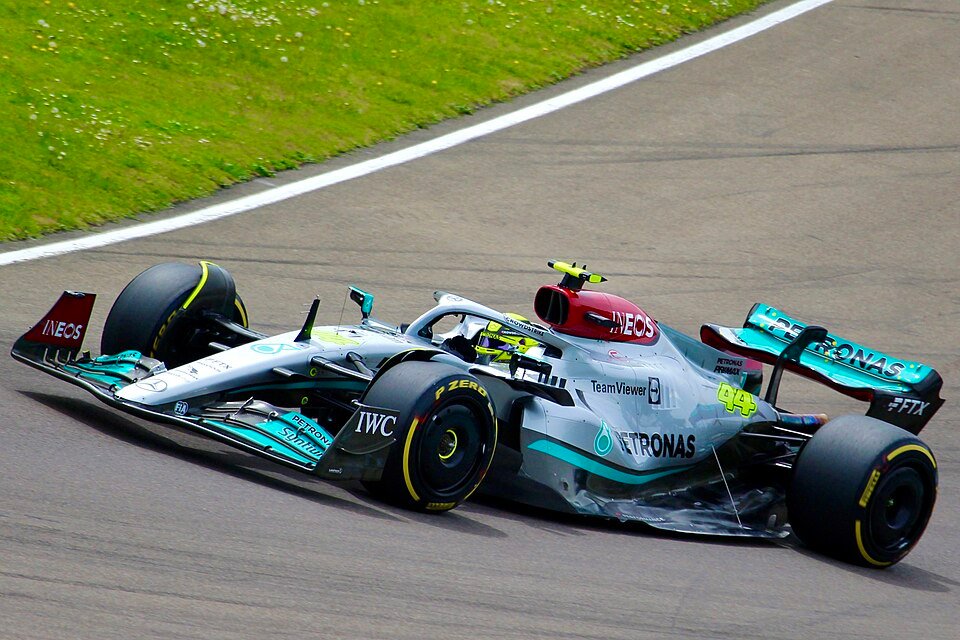
The 2022 regulations represented an even larger shift, but this time the governing bodies approached the task differently. F1 and the FIA took the lead in shaping the rules, leveraging technology far beyond what teams could deploy under their own aerodynamic testing restrictions. Central to this was a partnership with Amazon Web Services (AWS), whose cloud computing resources enabled computational fluid dynamics (CFD) simulations at unprecedented scale and speed.
Rob Smedley, F1’s lead engineer, described the impact: “It has somewhat revolutionised and transformed the way that the FIA were able to write the rules.” The critical breakthrough was the ability to simulate two cars in proximity, essential for understanding wake behavior and its effect on a following car. Traditional team-level CFD, constrained by 192-core limits, could take around five hours for a half-car model of 100 million cells, and up to 14 hours for a full car with 200–250 million cells. Doubling that for two cars meant 550–600 million cells, stretching runtimes to four days per iteration—an impractical pace for iterative design.
AWS’s EC2 cloud service changed that equation. Initial runs used around 1,000–1,100 cores; later versions scaled to roughly 2,500 cores. This reduced the two-car simulation time from four days to just six to eight hours, enabling rapid design loops comparable to a team’s half-car runs but with full two-car fidelity. “The progress there in terms of tech was massive,” Smedley said. “That was enabled by us partnering with AWS and they were the real enablers and the key ingredient there to make that work.”
The aerodynamic concept underpinning the 2022 rules centers on semi ground-effect cars with an upwashing wake, intended to reduce the disruptive turbulence experienced by a trailing car. From a scientific standpoint, Smedley asserted, “there’s no doubt that the concept is fundamentally sound.” Yet he acknowledged the competitive reality: teams will relentlessly pursue performance, even if that erodes the following car’s advantage. “The fundamental truth is the teams will chase performance as quickly as they can, in whatever direction they can,” he said.
This awareness tempers expectations. No one within F1’s technical leadership is naïve enough to guarantee flawless execution from the outset. But the combination of advanced simulation capability, regulator-led design, and a robust starting architecture offers a higher degree of confidence than in past overhauls. As Smedley put it, echoing Ross Brawn’s philosophy, the goal is to make a step forward, learn from the first season, and iterate. “If we’ve made a step forward, and then there’s more fundamental steps we can take after that, after one year of learning in 2022, that’s great. Let’s continue to do that and let’s just continue to build a better sport.”