


Rice Material Boosts Electric Control 100-Fold for Cooler Computing
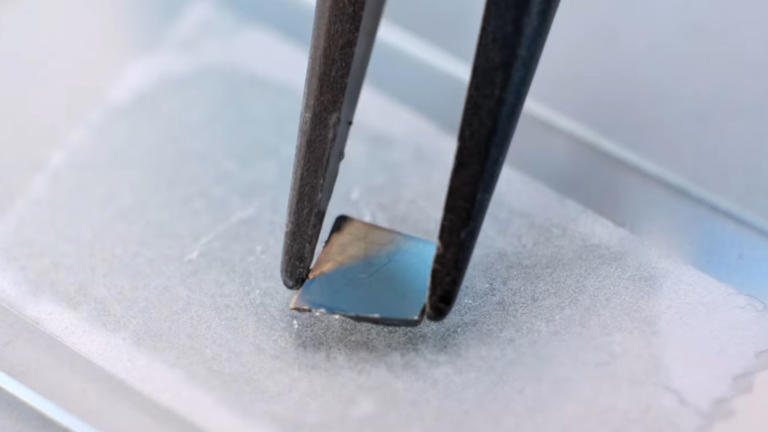
It has served silicon well, but the electricity bill might finally be catching up with it. At Rice University, scientists have created a multiferroic material at room temperature that challenges the established formula for computing hardware in terms of storing and transporting information with minimal loss of energy as waste heat. An improvement upon standard versions of bismuth ferrite, the material saw a 10 times boost in magnetization and a 100 times boost in magnetoelectric coupling, making computing methods not dependent on charge carriers a lot more intriguing again.
The promise of multiferroics isn’t novel, yet what prevented it from being utilized properly was their impractical nature. This type of materials combines polarizable properties with magnetic ones, and therefore is capable of demonstrating magnetoelectric control of its state. Essentially, this means memory and logical functions can potentially be performed with much lower power costs. However, finding room temperature multiferroics that exhibit both ferroelectric and magnetic behavior turned out to be difficult for researchers.
To address that issue, the Rice team used another famous candidate, bismuth ferrite, and added an amount of barium titanite to it while growing it under stress induced by the substrate. “Nobody had ever dialed both knobs the strain and the chemistry at once,” explained Lane Martin, materials scientist at Rice University. And the results were quite unexpected.
A nonmagnetic material somehow ended up boosting the total magnetism while retaining ferroelectricity at the same time. This material is exciting because of what we can do with it, Martin said. What makes multiferroics interesting is their magnetoelectricity, meaning electric control of magnetism or vice versa. Magnetoelectricity is critical for low-power spin-based computing concepts, where electricity can be used to switch spin states.
Of course, this phenomenon has much to do with the energy problem that computing industry faces. Electronics today have an energy problem, and I’m convinced that within the next five to 10 years, we’re going to use up to a quarter to a third of all power generation on computing. This perspective clearly contributes to the shift from simply making transistors smaller to seeking ways of reducing power consumption per operation.
One of the directions in which other researchers try to go about this issue involves alternative heat-spreading materials. For example, UCLA scientists recently demonstrated an approach where boron arsenide proved to be far better in dissipating heat away from powerful chips compared to traditional coolers like diamond and silicon carbide.
Rice’s achievement is still quite distant from a packaged processor, however. But its significance lies in demonstrating that multiferroics can actually be created rather than just discovered. According to first author Tae Yeon Kim, “I did not expect such a large increase in magnetization,” It took the team more than half a year to reproduce the experiment several times and prove that this effect is reproducible and genuine. The paper was published in the Proceedings of the National Academy of Sciences. All in all, the breakthrough has given the field not only another potential material, but a recipe for creating them in general.