

Musk Wants a Million Satellites to Compute in Sunlight Engineers See the Bottlenecks
“The satellites will actually be so far apart that it will be hard to see from one to another,” this was what Elon Musk wrote on X when he was countering the idea that the constellation of orbital data-centres would significantly increase the risk of collisions. The claim is put into an orbit which is already occupied, mechanically limited, and more sensitive to rare and critical failure modes.
The idea is simple to sum up: take some computing to space to access nearly endless solar power and avoid Earth-related restrictions on electricity, land, and cooler water. The resultant constraints are less intuitive. Low-Earth orbit does provide long-solar exposure – particularly in sun-synchronous orbits – but it also subjects structure to hardening needs, requires large radiators to dissipate heat in vacuum and turns every kilogram of structure into launch cadence and replacement cadence.
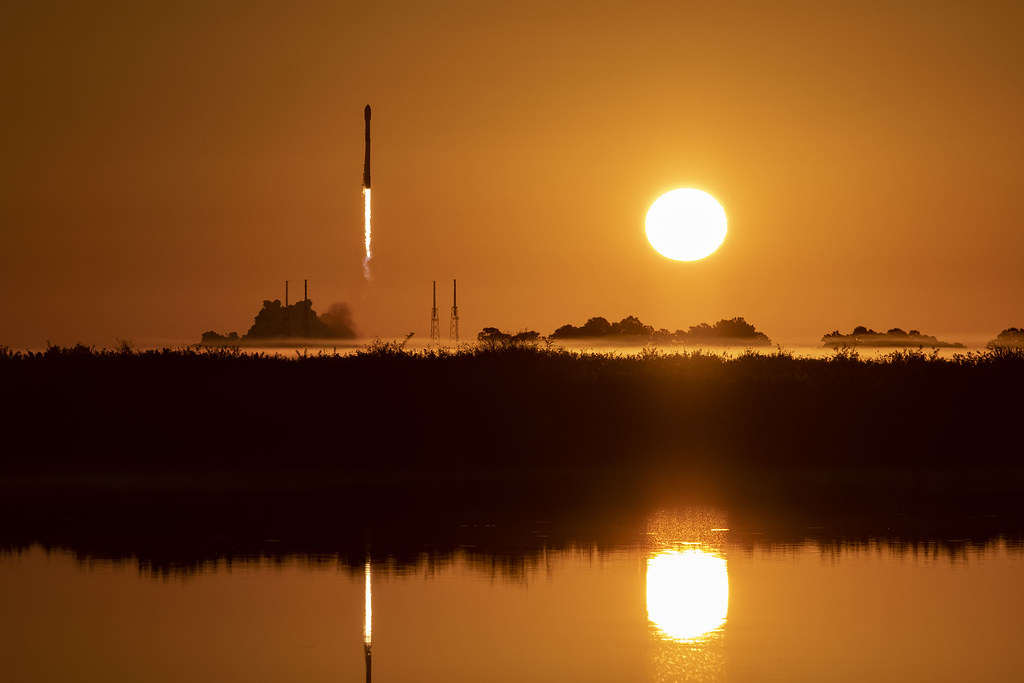
The application by SpaceX with the FCC is to allow up to 1 million satellites, to facilitate solar-powered, on-orbit processing. The concept has been described by Musk as the scaling of the latest generation of Starlink to have optical links and the company has been making Starship development lean towards bulk deployment. The recent Starship test launch, which launched Starlink v3 mass simulators, highlights the centrality of the dispenser mechanics and vehicle stability to the plan; that in-space choreography, rather than the marketing buzzword “data center,” is what is needed to allow a constellation to be fielded without transforming routine operations into constant risk control.
The fact that risk management is already a full time activity on the part of the operators. Within LEO mega-constellations, within less than 1 km there is an event of “close approach” in 1 in 22 seconds and within Starlink 1 in 11 minutes. The identical analysis approximates that each Starlink satellite makes an average of 41 course corrections annually. Those numbers tell about the system that functions quite successfully due to the fact that it never ceases listening. It does not take many short paragraphs: the focus can be lost.
Solar storms describe how a safe constellation in steady-state can be put at risk at the periphery. Orbit uncertainty and drag are heightened by atmospheric heating, and both navigation and communications may be impaired by interference, exactly the situations that cause satellites to move more frequently and at the same time, to be more difficult to command. In the May 2024 “Gannon Storm,” over fifty percent of LEO satellites allegedly used fuel to maneuver. A framing of the research has suggested a “CRASH Clock,” according to which as of mid-2025 a catastrophic collision will be imminent, at about 2.8 days following complete loss of collision-avoidance command, an unpleasant timescale to systems whose operation requires world wide coordination and constant telemetry.
The other limiting factor is thermodynamics. By putting compute in orbit, waste heat is not removed; conversely, convective cooling is. Radiators on a large scale need to be launched, implemented, and maintained at point within reasonable range, and fault tolerant and shielding architectures are top-level design requirements as particle radiation is flipping bits and accelerating electronics. Even those advocates who emphasize the abundance of the sun have to bump into a banal cycle: chips and power electronics do not last indefinitely, and renewing them requires long-term launch logistics and controlled reentry logistics, and not a single build out.
Orbital computing projects are gradually basing their approaches around the idea of sun-synchronous orbit to ensure that the solar arrays remain in the sun, with the SpaceX implementation proposing shells of between 500 and 2,000 kilometers. That altitude range might alleviate some crowding pressures in certain bands, but that does not free a million-object architecture of exceptionally good station-keeping, predictable end-of-life disposal, and sound autonomy when the space environment makes communications unreliable. The engineering competition is no longer whether a satellite can host compute; it is whether the entire operation stack can continue to power and precisely coordinate a large number of satellites over years-long periods of time.