

How an Antarctic Volcano Carved Giant Cloud Whirlpools Seen From Space
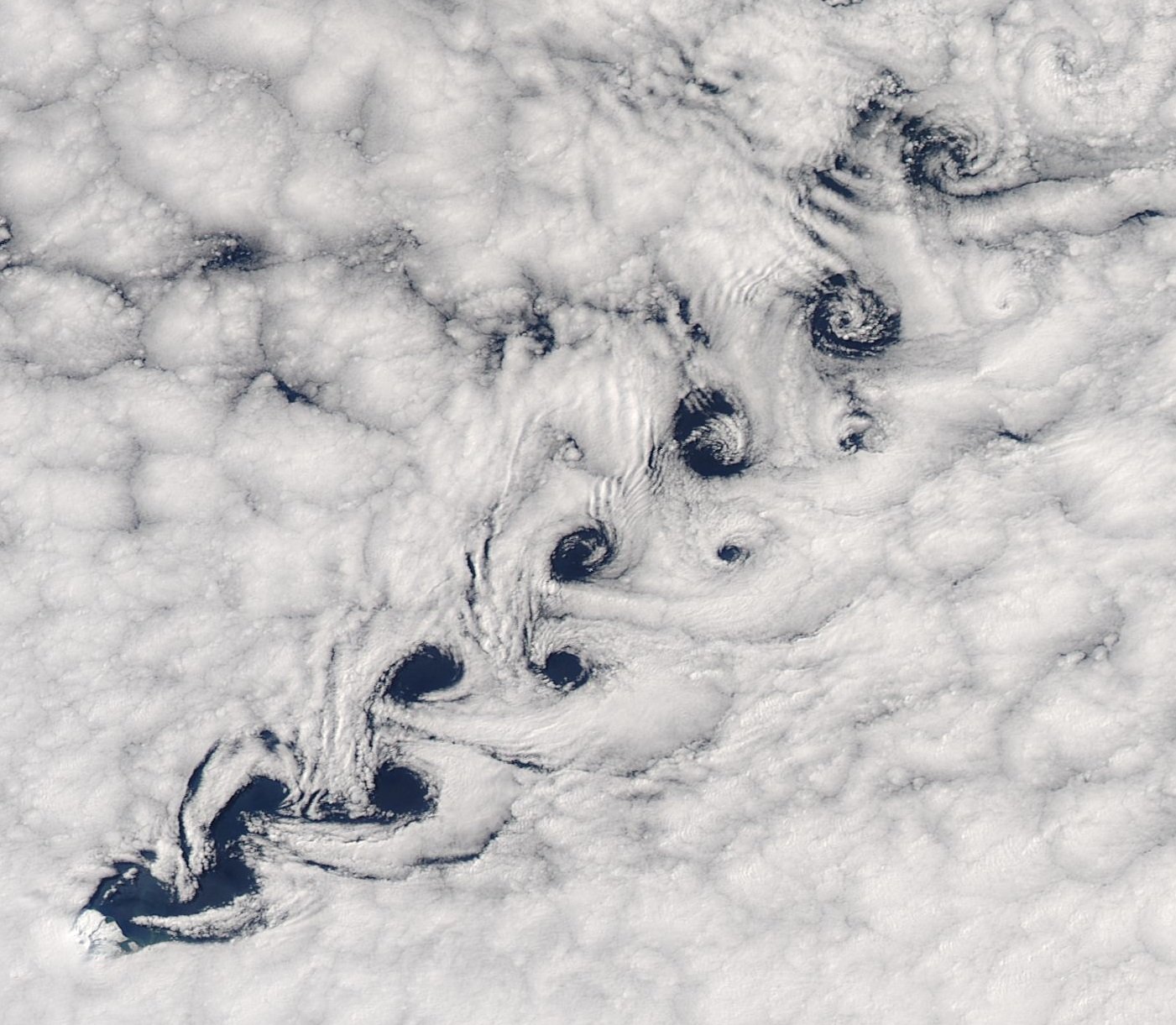
A far-flung remote island in the Antarctic recently transformed a hidden wind current into one of the best natural examples of fluid dynamics seen from space. The phenomenon was seen near Peter I Island, a volcanic island off Antarctica covered in snow and ice and uninhabited by people, where high-speed winds met rugged terrain and formed a pattern of repeating cloud vortices. This phenomenon, captured by NASA’s Landsat 8, is called von Kármán vortex street. This refers to a fluid dynamic process where alternating vortices peel off from behind the barrier as the fluid flows around it. In this particular example, winds blowing over the volcanic island measured between 11 and 34 miles per hour, providing enough force to form and maintain eddies without turning them into turbulence.

While the phenomenon looks impressive in images, it follows the laws of nature seen in many other situations. For instance, fluid dynamics dictates that von Kármán vortex street can occur anywhere, including in a cloud deck near an isolated volcano in the Antarctic, in the formation of harmonics produced by the wind flowing around hanging power lines, or the design considerations needed for tall towers. When alternating forces acting perpendicular to the flow hit the object in a way that matches the natural frequency of the structure, oscillations can build up and cause vibrations. As such, the cloud phenomenon is not only visually impressive but also a lesson in how engineers deal with crosswinds in their designs.
The conditions on Peter I Island allow for the occurrence of this phenomenon due to its characteristics. The small, uninhabited volcanic island located in the Bellingshausen Sea reaches heights of approximately 1,615 meters, allowing for disruption of flow caused by wind currents moving around. When the cloud layer is located at an appropriate height above the surface, the vortex can be captured from space as two rows of clouds with rotating vortices. Similar patterns have been recorded around Guadalupe Island, Jan Mayen and several volcanic island chains. Cloud vortex streets have been observed extending more than 400 kilometers in length with each swirl measuring dozens of kilometers.
Earth-observing satellites like Landsat 8 provide valuable information to scientists, not merely pictures. For example, Landsat 8, launched into space in 2013, used its Operational Land Imager to record the phenomenon. Satellites like those in the Landsat, GOES, Suomi-NPP, and NOAA-20 mission groups have captured images showing the same phenomenon, but each observation is valuable since each of these events requires specific conditions of altitude, topography, and wind strength to occur. Vortex street captured by a satellite camera from space may appear like abstract art, but it actually shows one of nature’s secrets revealed through the perfect alignment of wind, clouds, and geography.