

Why Gateway’s PPE Treats Electricity as the Mission’s Main Fuel
Within a vacuum chamber at NASA’s Glenn Research Center, a 12-kilowatt Hall thruster ejects a characteristic blue plume a picture that encapsulates a pragmatic shift occurring in cislunar spacecraft architecture: missions that budget power in the same way they once budgeted propellant.

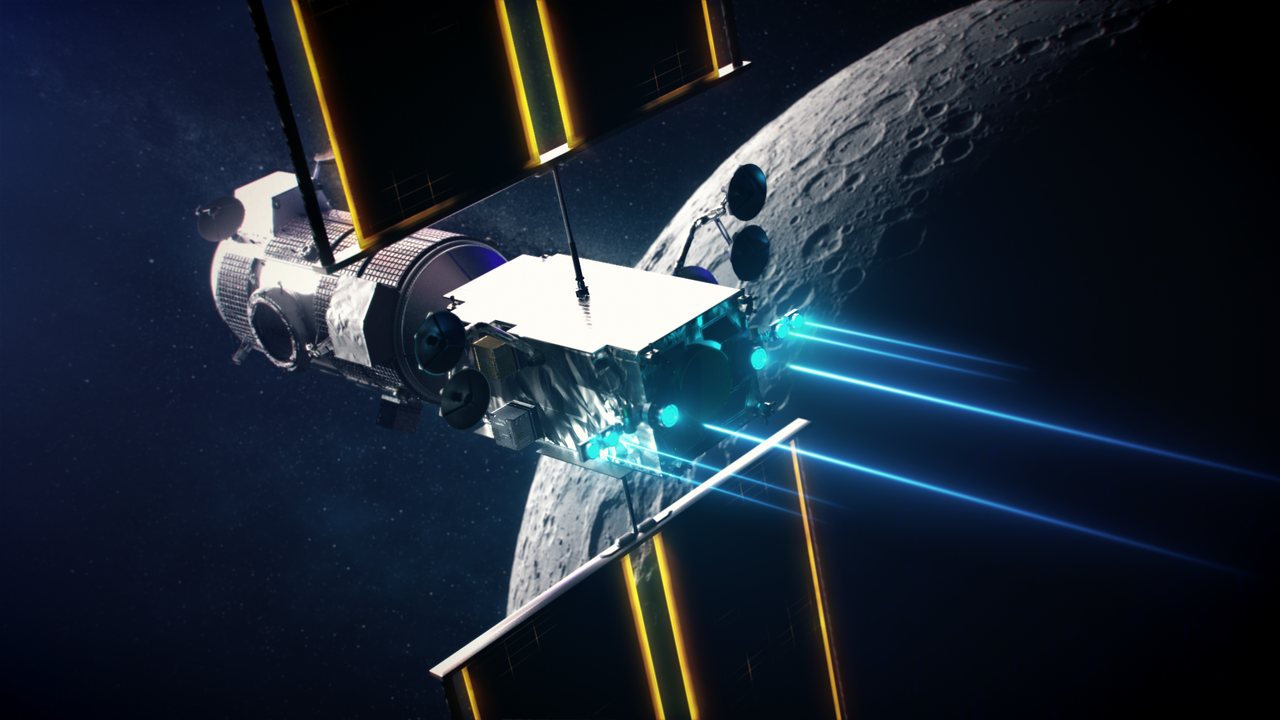
Gateway’s Power and Propulsion Element (PPE) is at the heart of this transition. Instead of propulsion being a periodic function, which chemical propulsion accomplishes through a burn, PPE is intended to make continuous electrical activity generation, distribution, and propulsion part of the station’s enabling infrastructure. This is significant because Gateway’s intended orbit around the Moon requires both endurance and agility: it must maintain a sophisticated orbit while supporting communications and visiting spacecraft, and have enough margin to grow as more modules are added.
In an interview about the program, Lanteris Space executive Chris Coker said of PPE: “PPE represents a ‘best of both worlds’ approach —combining NASA’s oversight with proven commercial spacecraft practices.” The technological thread that runs through this philosophy is one of scalability, with a power and propulsion core that can be scaled without having to rebuild the spacecraft. The Lanteris 1300 spacecraft has successfully launched more than 100 spacecraft to date, Coker said, and the goal is not to reinvent the wheel when it comes to reliability.
The electrical scale of PPE is key to this concept. According to NASA, The element generates 60 kilowatts of electrical power, which is used to support station subsystems and solar electric propulsion. The concept relies on roll-out solar arrays, which are large flexible blankets that sacrifice panel architecture for efficiency and space in deployment. The effect of this is that the generated power is used to create momentum through the ionization of xenon gas that is then accelerated by electric thrusters, which result in low thrust but high efficiency over a long period. The effect of this is the ability to perform long and precise propulsion maneuvers that increase the set of accessible or maintainable orbits without the need to carry chemical propellant designed for large maneuvers.
This same power is also the utility service for the station. In addition to propulsion, PPE must also offer attitude control and high-rate communications links between the vicinity of the moon and Earth, in addition to being the “power strip” for the various elements that interface with it for their use of its generation and storage capabilities. NASA’s Gateway concept combines PPE with the Habitation and Logistics Outpost (HALO) as the initial design, and later uses modules supplied by partners that utilize the same electrical infrastructure. In this way, PPE is more of a platform for expansion than a “bus,” which is consistent with the program’s assembly strategy.
Applying the heritage of commercial spacecraft to the cislunar environment, though, is no straightforward scaling exercise. Coker pointed to component selection and validation for radiation hardness, autonomy, and long-range communications, explaining how past deep space experience, such as that related to Psyche, contributed to setting up an initial design foundation. NASA, on the other hand, has characterized qualification as a key gate, pointing to ongoing efforts to qualify the advanced electric propulsion system for flight. The thruster complement itself is a multi-string concept, according to NASA, which lists three AEPS thrusters designed for PPE, while recent program developments have also mentioned additional electric thrusters to expand the range of operation and offer redundancy.
The end result is a spacecraft that relies on sunlight, and not stored propellant, as the key enabler of both propulsion and station-keeping. In the case of Gateway, it’s not just about efficiency it’s about the ability to convert electrical power into mission flexibility one blue plume at a time.