

Programmable CNC-Hydrogel Composites for Soft Robotics
A novel class of programmable, self-healing hydrogel nanocomposites has been developed by combining cellulose nanocrystals (CNCs) with zwitterionic copolymers of 3-dimethyl(methacryloyloxyethyl) ammonium propanesulfonate (DMAPS) and methacrylic acid (MAA). The design leverages the mechanical reinforcement and anisotropic alignment potential of CNCs, alongside the stimuli-responsive and self-healing characteristics of DMAPS-MAA hydrogels. The copolymerization of sulfobetaine methacrylates with small amounts of MAA enhances mechanical strength through hydrophobic associations, while dynamic electrostatic interactions and hydrogen bonding confer self-healing capability.

Initial formulations without chemical crosslinkers yielded physically crosslinked hydrogels, with a 3:1 DMAPS:MAA ratio (GelWC) showing robust tensile properties and complete mechanical recovery after 4–6 hours of self-healing. The elastic modulus of ~30 kPa aligns with that of soft biological tissues, enabling safe interaction in biomedical contexts. GelWC demonstrated pH-triggered swelling/deswelling due to ionization of MAA’s –COOH groups, though reversibility was limited by degradation after one cycle. Introducing N,N?-methylenebis(acrylamide) (BIS) at a 167:1 comonomer:BIS ratio produced chemically crosslinked hydrogels (Gel) with repeatable pH responsiveness.
To induce structural anisotropy, CNCs were added at concentrations above 4 wt% to achieve a liquid crystalline phase. Shear alignment of CNCs in the precursor produced anisotropic hydrogels (AGel), while isotropic counterparts (IGel) were prepared without shear. Polarized optical microscopy revealed vivid interference colors in CNC-containing hydrogels, with AGel exhibiting uniform monodomain alignment along the shear direction. Two-dimensional X-ray diffraction and small-angle X-ray scattering confirmed CNC orientation, with Herman’s order parameter values of 0.03 (Gel), 0.49 (IGel), and 0.74 (AGel).
Anisotropic swelling behavior was pronounced in AGel, with expansion greater perpendicular to CNC alignment. Rheology tests showed all hydrogels behaved as solids (G? > G?), though CNC addition reduced storage modulus due to increased hydrophilicity. Tensile testing revealed AGel’s mechanical anisotropy: specimens stretched parallel to CNC alignment had higher modulus and strength than those stretched perpendicular, underscoring CNC reinforcement effects.
Self-healing performance varied with composition. At the microscale, step-strain tests showed complete recovery of G? and G? after high-strain disruption. At the macroscale, AGel achieved ~90% healing efficiency perpendicular to alignment and ~50% parallel, aided by CNC-enhanced water retention. The cut-and-paste assembly of Gel and AGel pieces demonstrated effective healing across interfaces.
The combination of in-plane and out-of-plane anisotropic swelling, anisotropy gradients through thickness, and tailored geometry enabled programmable 2D-to-3D shape morphing. Finite element simulations predicted bending or helicity based on CNC alignment relative to strip orientation, verified experimentally with pH-triggered deformation. AGel strips cut at 45° to CNC alignment twisted into helices, with pitch tunable by cut angle. Constructs assembled from multiple pieces exhibited complex, reversible 3D morphing upon pH change.
Biocompatibility tests with fibroblast cells showed >95% viability over five days for all hydrogels except those with a flipped DMAPS:MAA ratio (1:3), which proved cytotoxic. On-demand degradation was demonstrated for GelWC in 10 wt% NaCl solution, driven by ionic disruption of zwitterionic associations. Chemically crosslinked variants were more stable but could be made degradable with suitable crosslinkers.
Thermal responsiveness was evident near the hydrogel’s upper critical solution temperature (~57 °C), with faster shape changes at physiological temperature (~37 °C). Mechanical properties and self-healing remained robust under these conditions.
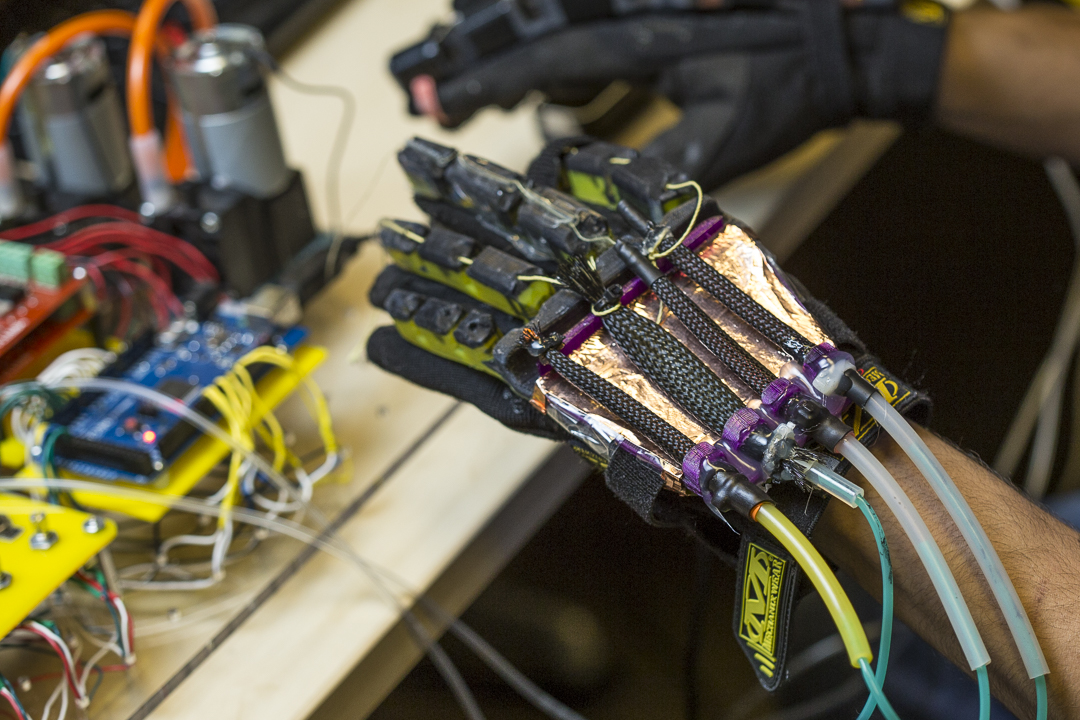
Soft robotic demonstrations included a tethered pH-responsive micro-gripper formed from AGel strips with perpendicular CNC alignment, capable of gently grasping and releasing spherical or irregular cargo. An untethered robot, cut at ~60° CNC alignment for tighter helices, was equipped with a magnetic IGel patch containing Fe??/Fe??-decorated CNCs, enabling remote navigation through a flooded maze. Cargo manipulation was triggered by pH-induced twisting and untwisting. Dynamic moduli measurements indicated that high-pH swelling increased stiffness due to chain stretching, while low-pH swelling had minimal effect.