

Volocopter’s VoloCity Completes First Full-Scale Flight
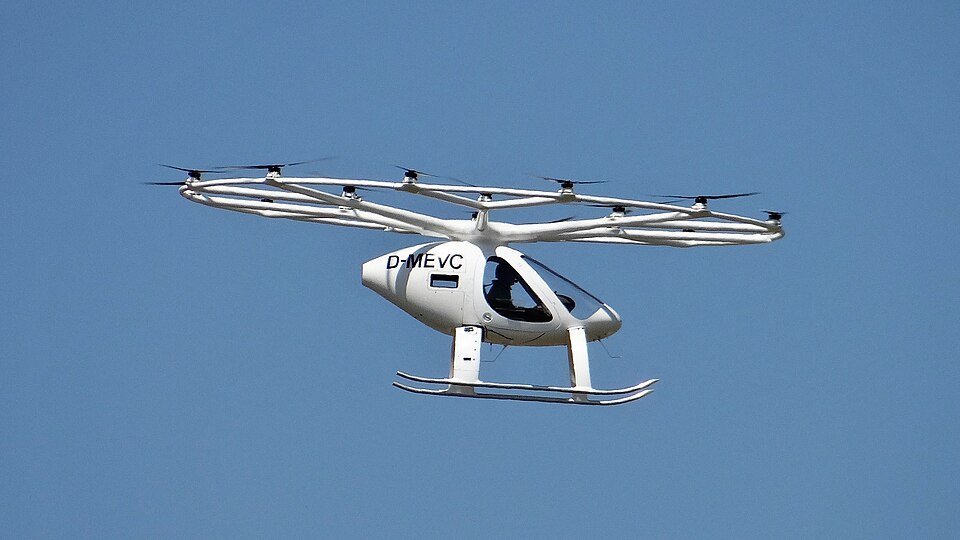
On a cold December morning in Bruchsal, southern Germany, Volocopter’s engineering team watched as years of design iterations and incremental testing converged into a singular milestone. The company’s full-size VoloCity electric vertical takeoff and landing (eVTOL) air taxi prototype rolled out from its hangar, taxied to the airfield, and ascended into the sky for its maiden flight. “On a chilly December morning, our team was excited because everything was finally coming together,” said Volocopter. “As the VoloCity emerged from the hangar and moved into the airfield, we held our breath for the flight test we’d been waiting no less than 11 years to conduct!”
The VoloCity represents the culmination of over a decade of development, including more than 1,500 test flights across earlier prototypes. The aircraft’s design is centered on urban air mobility, with an emphasis on safety, efficiency, and zero-emission operation. Its distinctive architecture features 18 rotors mounted above the cabin, driven by nine rechargeable battery packs. This configuration provides redundancy in both propulsion and power supply, a critical factor in passenger-carrying eVTOL systems. The craft’s operational parameters include a maximum range of 35 kilometers and a top speed of 110 kilometers per hour, optimized for short urban hops rather than long-haul journeys. The cabin accommodates two passengers and small hand luggage, reflecting its role as a point-to-point aerial transport solution.
Volocopter’s stated ambition is to have the VoloCity ready for commercial service during the 2024 Paris Olympics. The company envisions a booking process as simple as ordering a ride via smartphone, integrating aerial mobility into existing urban transport networks. “Today, we celebrate a remarkable achievement: the culmination of our aspiration to create a better future in which electric aircraft and emission-free flights are the new dimension of global mobility,” the team declared. “As Volocopter taxis toward this new frontier, it will make urban flights just a few smartphone clicks away. These moments demonstrate how our pioneering spirit will bring our vision to life before our very eyes. And it’s just the push we need as we enter the final leg of the race to commercial launch.”
From an engineering perspective, the VoloCity’s distributed rotor system offers several advantages. By using multiple smaller rotors rather than a few large ones, the aircraft can achieve lower disk loading, improving efficiency in hover and reducing noise—a critical consideration for urban deployment. The modular battery system allows for rapid swapping between flights, minimizing downtime and enabling continuous operation in high-demand environments. The flight control architecture must manage the simultaneous thrust and torque outputs of all 18 rotors, requiring sophisticated algorithms and robust sensor integration to maintain stability in varying wind and load conditions.
The maiden flight in Bruchsal was followed by additional testing at Pontoise airfield northwest of Paris, part of the preparation for regulatory certification and operational readiness. These trials evaluate not only flight performance but also ground handling, charging logistics, and passenger boarding procedures. For urban air mobility vehicles, certification pathways involve both aviation authorities and municipal regulators, ensuring compliance with noise, safety, and airspace integration requirements.
Volocopter’s progress reflects broader momentum in the eVTOL sector, where multiple companies are competing to define the future of short-range aerial transport. The push toward electric propulsion aligns with global efforts to reduce emissions in transportation, and the relatively compact footprint of eVTOL aircraft offers potential to bypass congested road networks. However, achieving widespread adoption will depend on infrastructure deployment, public acceptance, and the maturation of battery technology to balance range, payload, and turnaround time.
The VoloCity’s first full-scale flight marks a significant technical and symbolic step toward operational urban air mobility. For engineers and enthusiasts tracking this emerging field, it demonstrates how sustained iteration, rigorous testing, and clear commercial targets can transform a concept into a tangible aircraft now lifting off under its own power.