


DHL Ends Parcelcopter, Shifts to Middle-Mile Air Logistics
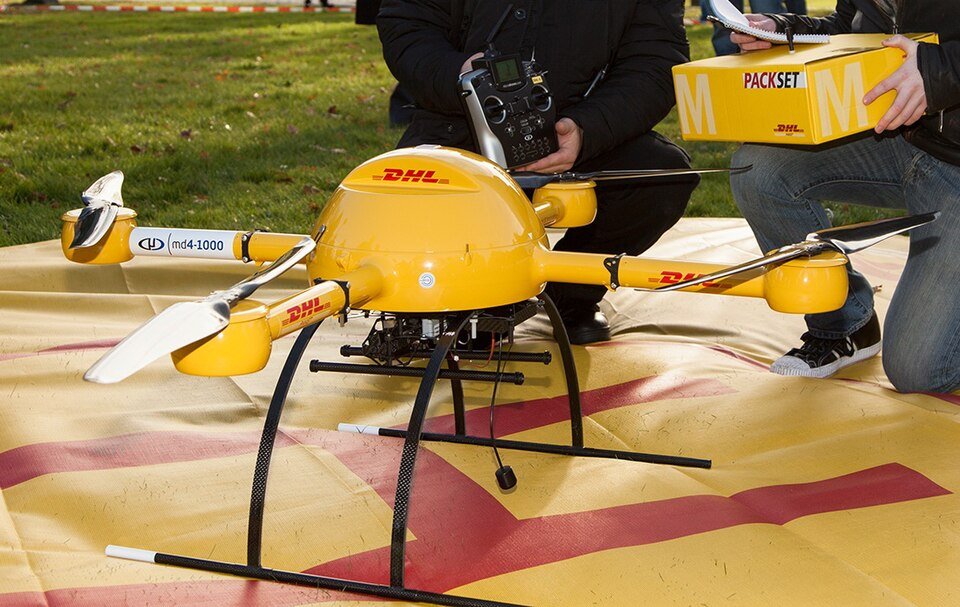
DHL has confirmed it will no longer pursue its Parcelcopter delivery drone program, ending an eight-year effort that once positioned the company as the first parcel service provider to integrate a drone directly into its logistics chain. The decision marks a definitive close to a project whose last prototype for consumer deliveries was developed in 2018. Speaking to reporters in Germany, company representatives stated that DHL would neither continue testing the Parcelcopter nor manufacture its own drones.
The announcement closely follows news from the United Kingdom, where Amazon has effectively shut down its Prime Air drone delivery program in the country, laying off more than 100 employees and transferring many others. The parallel timing underscores a broader cooling in the consumer-facing drone delivery sector, where technical, regulatory, and economic challenges have proven persistent.
DHL, a division of Deutsche Post, began its drone development work in 2013. The Parcelcopter’s inaugural flight in December of that year saw a quadcopter carry a small package one kilometer across the Rhine River. Over the years, the platform underwent multiple redesigns and optimizations, evolving into more capable configurations. The most recent publicized deployment involved a collaboration with GIZ, a sustainable development organization, and German drone manufacturer Wingcopter. In that project, the Parcelcopter 4.0 was used to transport medicines to remote communities in eastern Africa, demonstrating the potential for rapid, point-to-point logistics in areas with limited infrastructure.
Despite these successes, the company now frames Parcelcopter as a high-profile proof of concept rather than a commercially viable service. Jürgen Gerdes, management board member for post, e-commerce – parcel at DHL, stated: “We are more than convinced that the Parcelcopter has allowed us to create real added value in the field of logistics. In the future, this could take the shape of deliveries of emergency medical supplies or deliveries to regions situated in a challenging geographical location. The parcelcopter arguably allows us to offer people in such areas a new kind of access to the flexible and, most importantly, rapid dispatch and delivery of goods.” His remarks also acknowledged the prevalence of “unrealistic hype” in the drone industry, where both startups and established firms have at times overpromised on the readiness of their technology.
While stepping back from last-mile autonomous delivery, DHL has been increasing its focus on middle-mile aerial logistics. This segment, which covers medium-distance routes between distribution hubs, offers different technical and regulatory dynamics than direct-to-consumer drone flights. In July, DHL partnered with Bulgarian manufacturer Dronamics to explore medium-distance, cross-border, and inter-city missions using uncrewed aircraft optimized for cargo. These operations aim to bridge regional gaps in freight movement, potentially reducing transit times without the complexity of urban drone navigation.
The company has also invested in crewed electric aviation for feeder networks. It recently ordered 12 Alice aircraft from Seattle-based Eviation. The Alice is a battery-powered, single-pilot airplane designed for middle-range routes. Its configuration allows it to operate from existing airport infrastructure with minimal modification, an important factor in accelerating deployment. DHL has indicated plans to begin operations in the United States, starting on both coasts, with California as the first location. By integrating such aircraft into its network, the company seeks to enhance efficiency on routes where ground transport is slower or less economical.
The shift from experimental last-mile drones to scalable middle-mile solutions reflects a strategic recalibration. While the Parcelcopter demonstrated technical feasibility and humanitarian utility, the economic and operational realities of widespread consumer drone delivery remain unresolved. Middle-mile aerial logistics, by contrast, leverages larger payload capacities, established air corridors, and existing regulatory frameworks, making it a more immediate fit for integration into global freight systems.