

Ingenuity Expands Mars Flight Role as Perseverance Begins Science
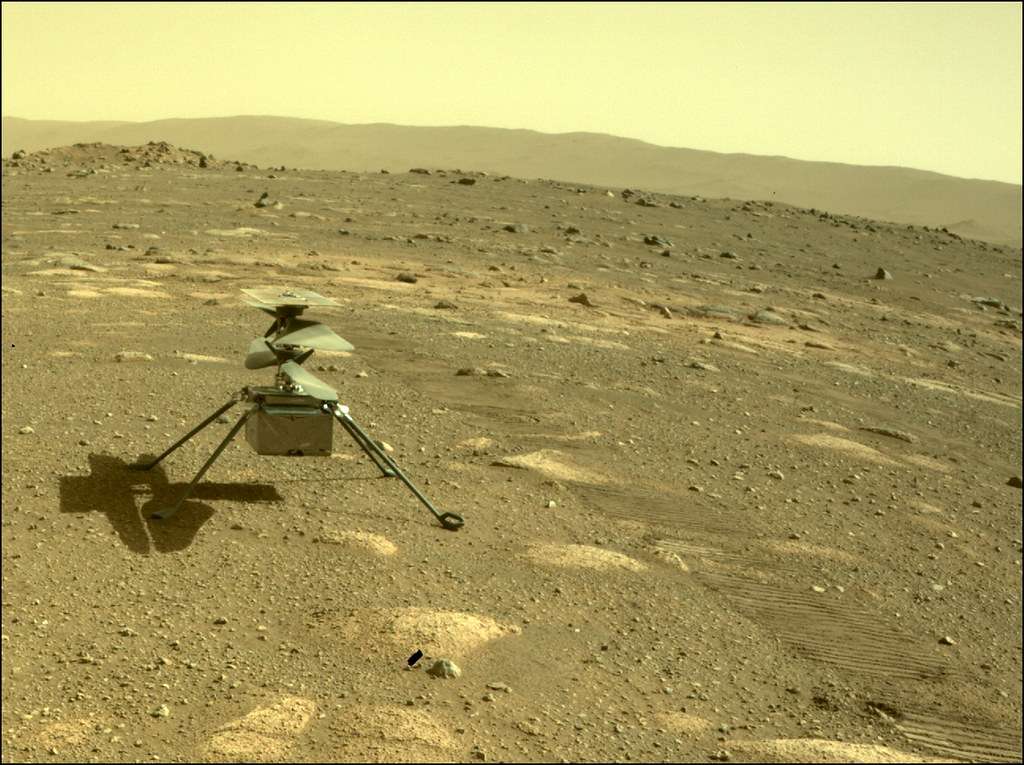
Nearly three months after its arrival on Mars, NASA’s Perseverance rover has transitioned from system checkouts to active science operations, while its companion, the Ingenuity helicopter, has entered a new operational demonstration phase. This shift marks a significant milestone in the Mars 2020 mission, as the rotorcraft now supports reconnaissance for science target selection in Jezero Crater.
On May 7, Ingenuity completed its fifth flight, covering 129 meters south of Wright Brothers Field before ascending to a record-setting altitude of 10 meters. The 108-second flight began at 19:26 UTC, capturing high-resolution images of the surrounding terrain from its new location, designated Airfield B. Bob Balaram, chief engineer for Ingenuity at NASA’s Jet Propulsion Laboratory (JPL), remarked, “We bid adieu to our first Martian home, Wright Brothers Field, with grateful thanks for the support it provided to the historic first flights of a planetary rotorcraft.”
Ingenuity’s journey to Mars was made possible by Perseverance, which carried the 1.8-kilogram helicopter through interplanetary space before deploying it to the surface. On April 19, 2021, Ingenuity achieved the first powered, controlled flight by a heavier-than-air machine on another planet—117 years after the Wright Brothers’ pioneering flight on Earth. As a tribute, a small piece of fabric from the original Wright Flyer was incorporated into Ingenuity’s structure, linking two historic firsts across worlds.
The helicopter’s flight record includes a series of progressively complex maneuvers. Its debut involved a vertical climb to 3 meters, hover, rotation, and safe landing in 39.1 seconds. The second flight reached 5 meters altitude, moved laterally for 2 meters, executed three turns, and remained airborne for 51.6 seconds. The third extended its range to 50 meters at 2 m/s airspeed. A technical hiccup delayed the fourth flight by a day, but it ultimately completed a 266-meter round trip, gathering aerial imagery for terrain analysis.
Ingenuity’s systems have exceeded expectations. Its power unit, designed for 350 watts over 90 seconds, has delivered consistent performance, while its rotor blades have demonstrated an unexpected benefit—shedding dust from the solar panels during flight. This dust mitigation capability could inform future solar-powered designs for Mars, where airborne particles pose a persistent challenge.
Balaram noted, “The plan forward is to fly Ingenuity in a manner that does not reduce the pace of Perseverance science operations. We may get a couple more flights in over the next few weeks, and then the agency will evaluate how we’re doing.” He added, “We have already been able to gather all the flight performance data that we originally came here to collect. Now, this new operations demo gives us an opportunity to further expand our knowledge of flying machines on other planets.”
While Ingenuity advances aerial exploration, Perseverance has begun deploying its suite of scientific instruments. Among the early successes is MOXIE—the Mars Oxygen In-Situ Resource Utilization Experiment—which on April 20 produced 5.4 grams of oxygen in one hour from the planet’s carbon dioxide-rich atmosphere. The 17.1-kilogram device, roughly the size of a car battery, uses solid oxide electrolysis at 800°C, with a gold coating to shield the rover from heat. MOXIE will operate at least nine more times over the next Martian year, testing oxygen production under varying conditions to guide the design of future, larger-scale systems capable of generating rocket oxidizer and breathable air.
Another key technology demonstrator, the Mars Environmental Dynamics Analyzer (MEDA), has been recording daily weather data, including dust particle size and concentration, surface radiation, wind patterns, temperature, pressure, and humidity. Such localized measurements are essential for planning crewed missions, complementing global datasets from orbiters like the UAE’s Al-Amal.
Perseverance’s initial science campaign focuses on the ancient lakebed within Jezero Crater. The rover is expected to collect its first samples from nearby mudstone formations before heading toward the fossilized river delta. This traverse will expose the rover to varied geological contexts, offering clues to Mars’ past habitability and the processes that shaped its surface.