


Trinity Test Glass Hid a Crystal Modern Labs Still Cannot Make
More than 80 years after the Trinity test transformed desert sand and vaporized metals into glass, the site continues to produce materials that have never been reproduced in any modern laboratory. Scientists examining a rare red trinitite sample discovered a silicon-based clathrate crystal that seems to have only formed because the nuclear detonation briefly put matter in a highly unstable physical state.

The significance of the discovery goes beyond the legacy of the world’s first nuclear bomb detonation. It proves how short bursts of heat, pressure, and fast cooling can push atoms into states that conventional synthesis cannot easily produce, thus preserving evidence of conditions that lasted for just a few seconds.
Trinitite is an unusual material in its own right a glass created during the explosion of 1945 by melting down desert sand, asphalt, tower fragments, and instrumentation equipment. The majority of its samples are green, while the rare red or “oxblood” variety is richer in metal due to its proximity to the destroyed test structure. The new study became especially informative due to that red color since it allowed researchers to analyze droplets of metal that were preserved within the glass.
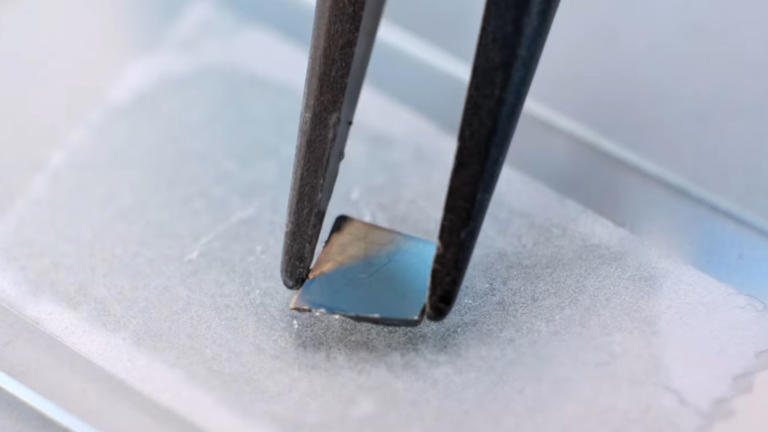
With the help of X-ray diffraction and microprobe analysis, the team found a new calcium-copper-silicate clathrate in a droplet containing high levels of copper. In a clathrate, silicon creates a framework of cages that traps other atoms inside. Among the observed shapes of the cages were dodecahedrons and tetrakaidecahedrons with 12 and 14 sides, respectively. Calcium was present in the cages, along with some copper and iron. According to Luca Bindi from the University of Florence, who was cited in the Scientific American article, “It’s a completely new kind of clathrate crystal something never seen before in nature or in the products of a nuclear explosion.” The specific circumstances of formation explain why the clathrate is so unusual.
During the Trinity test, the matter in the immediate vicinity of the explosion reached temperatures above 1,500 degrees Celsius and pressures of 5 to 8 gigapascals. Such conditions are capable of disrupting ordinary atomic configurations, while the rapid cooling can fix metastable arrangements before they stabilize into regular minerals. “This all happened in a matter of seconds, so atoms didn’t have time to arrange into stable structures, leading to unusual nonequilibrium materials like this one.” This explains why Trinity trinitite has become a unique natural record of matter created under extremely unusual conditions.
The discovery adds yet another level of complexity to an ongoing scientific discussion. In 2021, the same red trinitite yielded silicon-rich quasicrystals, an exotic crystalline structure that contradicts assumptions about solid-state atomic arrangement. Given that both quasicrystals and the recently discovered clathrates contain iron, silicon, copper, and calcium, the team analyzed whether one could transform into the other. Simulations showed that the process is unlikely to happen in this case, suggesting that two exotic structures formed independently in response to the violent conditions.
Thus, the new crystal makes a contribution to science beyond its historical significance. Studying trinitite may improve methods of forensic investigation of nuclear explosions, while also expanding the range of possible crystal structures for material sciences. “Extreme events like nuclear blasts, lightning, or impacts can generate new mineral phases and structures that expand our understanding of how matter organizes under extreme conditions,” notes Bindi.