

NASA’s Voyager Probes Are Running Out of Power and Every Watt Now Matters
Fifty years since launch, the Voyager spacecraft operate in an era in which a few watts determine whether an instrument will live another year. This is the reality when it comes to the only pair of missions left to collect information about the space beyond our solar system, a region which any new space missions cannot reach yet.
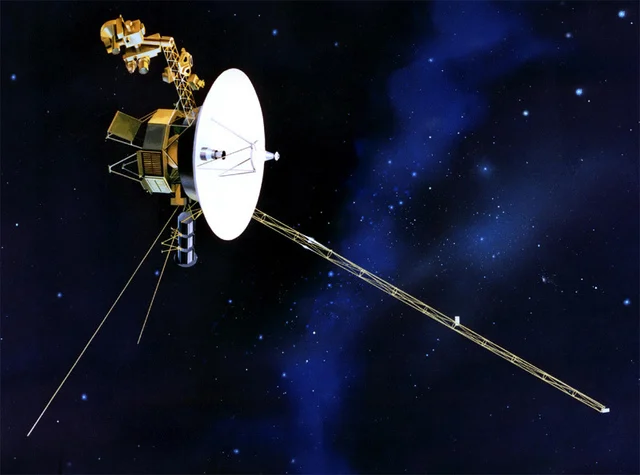
The Voyager 1 and 2 spacecraft were designed to conduct a planetary tour. However, the spacecraft outlasted their mission by decades to become interstellar observatories. The longevity of these spacecraft was enabled by a type of generator called radioisotope thermoelectric generators that transform the heat of radioactive material decay into electric energy via the Seebeck effect. Such power supply was attractive due to the reliability of the technology; nothing would move and thus break. However, the downside to the system is obvious the amount of generated electricity decreases steadily and, for Voyager missions, it is about 4 watts per year.
That continuous loss has prompted the mission team to adopt a strategy of triage in the deep space. In April 2026, NASA decided to stop operations of Voyager 1’s Low-Energy Charged Particles experiment after a sudden decrease in power during a pre-programmed roll maneuver increased fears that the spacecraft would activate its autonomous safe mode. This device had operated for almost 49 years, providing information about charged particle density and pressure in the interstellar medium. Mission Manager Kareem Badaruddin noted: Shutting down a science instrument may be painful, but it is the only way to do.
A power issue is not just a matter for science equipment. The spacecraft needs to continue sending data despite enormous distances and the temperature drop below the point of freezing the propellant lines. Suzanne Dodd, Voyager’s Project Manager, mentioned in 2022 that the transmitter required about 200 watts. In December 2024, according to Voyager’s Mission Scientist Alan Cummings, the spacecraft would have approximately 230 watts each available to spend. There is little room left for power reserve.
It is why NASA plans to conduct an engineering maneuver dubbed the Big Bang. Three devices, responsible for preventing the freezing of the thruster fuel lines, will be turned off while the replacement components will be activated. This operation is expected to save at least 10 watts. NASA hopes to prolong the lifetime of one science device by one year at least. Voyager 2, which is closer to Earth and thus has extra margin, will be the first spacecraft to test this engineering approach.
However, the mission currently relies on only a few scientific instruments. Only the magnetometer and plasma wave subsystem work on the Voyager 1, while Voyager 2 operates the same two components and the cosmic ray subsystem. This reduced number of science equipment seems modest. Still, the collected information remains unique since only these spacecraft are at the distance from our planet sufficient to sample that area. This is how the end of the mission will not happen abruptly but rather gradually. Each shutdown will come to ensure one more year of data transmission. According to Project Manager Suzanne Dodd, the spacecraft will last to their 50th anniversary in 2027, with a goal to achieve 200 AU in 2030.