

6G Airborne Networks Poised to Transform Urban Air Mobility
The rapid evolution of mobile networks, from the analog Total Access Communication Systems of the 1980s to today’s application-centric 5G, has consistently reshaped how vehicles connect and operate. Each generational leap—GSM’s digital voice, UMTS’s mobile broadband, LTE’s scalable bandwidth, and 5G’s ultra-reliable low-latency links—has expanded the scope of connected mobility. Now, with 5G deployments maturing, researchers are turning their attention to 6G as the communications backbone for Urban Air Mobility (UAM).
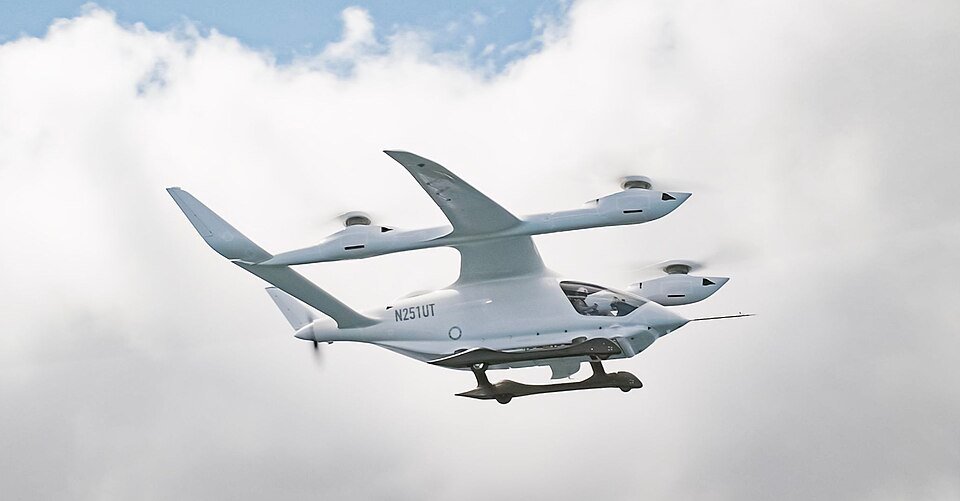
UAM envisions dense deployments of Unmanned Aerial Vehicles (UAVs) and Personal Aerial Vehicles (PAVs) operating in low-altitude urban airspace. UAVs already serve in roles from infrastructure inspection to emergency communications, while electrically powered vertical take-off and landing (eVTOL) craft are demonstrating passenger transport potential. Uber’s air taxi trials and Hyundai’s SA-1 concept have shown that the technology is viable. Yet scaling these systems demands an Airborne Wireless Network (AWN) capable of delivering sub-millisecond latency, high throughput, and near-perfect reliability.
The proposed 6G AWN architecture integrates terrestrial, airborne, and even underwater networks through a unified control plane supported by massive Virtual Network Functions. Low Earth Orbit (LEO) satellite constellations such as Starlink and OneWeb, along with high-altitude platforms like Project Loon, would extend coverage to aerial users and provide resilient backhaul. Base stations could dynamically switch between ground (gNB) and aerial (aNB) modes, with PAVs and UAVs acting as both user equipment and relay nodes. Antennas tilted skyward, as in the European Aeronautical Telecommunication Network, would further enhance connectivity.
Artificial intelligence is expected to be integral to 6G AWNs, orchestrating resources in response to rapidly changing aerial topologies. AI-driven radio planning in three dimensions could enable dynamic airway corridors for UAVs and PAVs, complementing NASA’s ongoing low-altitude airspace management research. Security will be paramount; as the authors note, “Security breaches to critical applications could potentially result in a fatality.” Technologies such as Quantum Key Distribution via satellites and UAVs, and Distributed Ledger Technology for privacy, are being explored to harden the network.
Several enabling technologies stand out. Millimeter-wave and terahertz bands promise vast bandwidths for line-of-sight airborne links, though range limitations will require solutions like massive MIMO and relay-based communications. Intelligent Reflecting Surfaces—passive, programmable arrays that steer signals—could be mounted on UAVs or buildings to extend coverage and improve privacy. LEO satellite backhaul, coupled with Multi-access Edge Computing, offers low-latency links critical for control and safety functions.
To support UAM, 6G networks must meet stringent Key Performance Indicators. Accessibility will determine whether aerial vehicles can reliably register and connect; integrity will encompass not only latency and throughput but also data security; utilization will track resource consumption to guide scaling; retainability will ensure Quality of Service for safety-critical flows; and mobility will require seamless 3D handovers between ground and aerial nodes. As 3GPP TR 36.777 outlines, aerial mobility KPIs include handover failure rates, radio link failures, and ping-pong effects—metrics that AI could help optimize.
Challenges remain formidable. Airspace control systems must be extended to incorporate AWN entities without compromising safety. Cybersecurity threats such as GPS spoofing and false data injection could undermine trust in autonomous aerial transport. Interference management, energy efficiency for dual-role aerial nodes, and effective RF planning in congested urban airspace all demand further research.
Opportunities lie in developing predictive AI for interference mitigation and handover management, advancing terahertz transceivers for short-range airborne links, and integrating Intelligent Reflecting Surfaces into both terrestrial and satellite segments. High-throughput LEO satellites must overcome the technical hurdles of frequent handovers and ultra-low-latency inter-satellite routing. Security research will remain critical, especially for applications where human lives are at stake.
The vision for 6G-enabled UAM is ambitious: a globally connected, AI-managed, secure airborne network where UAVs and PAVs operate as both consumers and providers of connectivity. Drawing on lessons from decades of mobile network evolution and the success of connected ground vehicles, the groundwork is being laid for a future in which urban skies become as navigable—and as connected—as city streets.