

Orbital Assembly Advances Ambitious Space Hotel Projects
Orbital Assembly Corporation (OAC), a California-based space development firm, has revealed significant progress on two orbital infrastructure projects designed to accommodate both research and tourism. The company’s timeline positions these ventures within a rapidly evolving commercial spaceflight sector, aiming to deliver artificial gravity habitats and luxury amenities in low Earth orbit.

The first of these platforms, Pioneer, is slated for operation by 2025. OAC’s specifications describe a modular architecture with between two and eight habitable modules and four to sixteen docking ports. Crew capacity ranges from 14 to 56 occupants, depending on configuration. According to the company’s official statement, “Pioneer-class stations will be the first habitable platforms capable of providing artificial gravity, unlocking unprecedented opportunities for research, tourism, and long duration spaceflight.” This artificial gravity capability, achieved through rotational motion, addresses a long-standing challenge in human spaceflight—mitigating the physiological effects of microgravity over extended periods.
Pioneer’s design reflects a balance between technical feasibility and market readiness. Smaller than traditional space stations, it can serve as a proving ground for the systems that will later be scaled up. Engineers have long recognized that modularity in orbital construction offers flexibility for expansion, maintenance, and adaptation to varied mission profiles. The inclusion of multiple docking ports suggests compatibility with a range of visiting spacecraft, from crewed capsules to cargo vehicles.
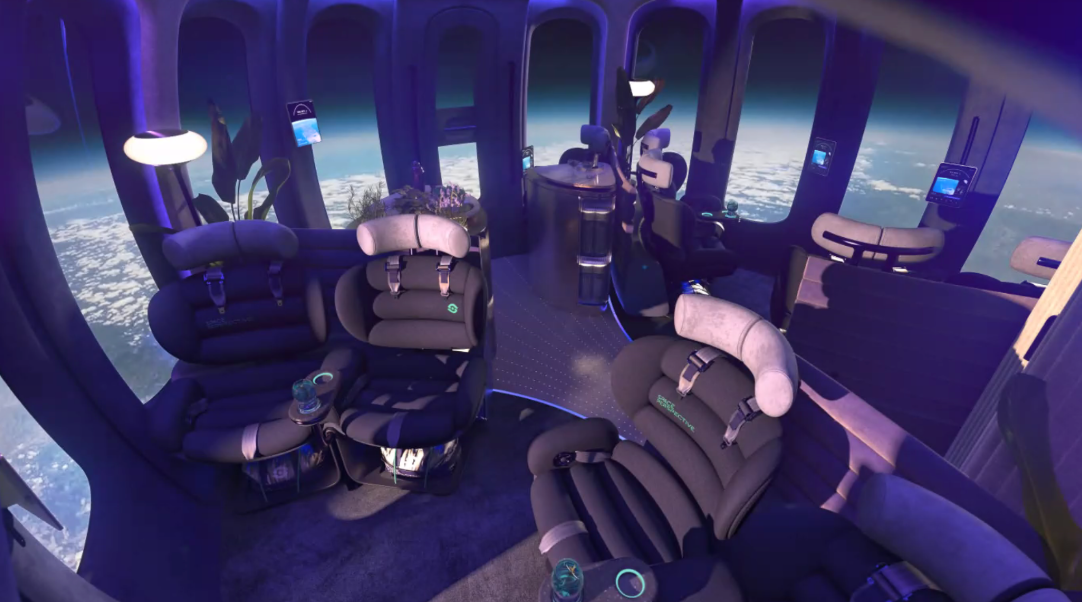
By 2027, OAC plans to deploy Voyager Station, a far larger facility capable of hosting 400 people, including 100 crew members. Initially announced in 2019 under the name Von Braun Station, the project pays homage to the aerospace engineer Wernher von Braun, whose vision of rotating wheel-shaped stations helped define mid-20th-century space architecture concepts. Voyager’s scale is striking: over 11,600 square meters of habitable space distributed among modules and access tubes. Continuous video monitors along interior walls will stream live views of Earth and the surrounding cosmos, leveraging both engineering and aesthetic considerations to enhance the experience for occupants.
Voyager’s 24 habitation modules will host diverse functions. Plans include a restaurant, gym, event center, research facilities, and private villas. Government-owned modules will be dedicated to scientific research, astronaut training, and mission staging. The integration of commercial and governmental uses within a single orbital platform mirrors patterns seen in terrestrial infrastructure, where shared facilities can foster collaboration and offset operational costs.
For prospective space tourists, the price of admission is steep—reports place the cost at approximately US$5 million per guest. This figure reflects the logistical complexity of orbital transport, life support, and station operations, as well as the exclusivity of the experience. The target market is small but influential, with potential to drive further investment into orbital hospitality and related technologies.
The timing of these developments is notable. The International Space Station (ISS), a cornerstone of human spaceflight for over two decades, is scheduled for decommissioning by 2030. OAC’s projects could help fill the gap in orbital presence, particularly for non-governmental actors. The emergence of privately operated stations aligns with broader trends in aerospace, where commercial entities increasingly undertake roles once reserved for national space agencies.
From an engineering perspective, the challenges are formidable. Artificial gravity requires precise rotational dynamics and structural integrity under continuous centrifugal forces. Habitability demands robust environmental control systems, radiation shielding, and redundancy in critical subsystems. Docking interfaces must accommodate diverse spacecraft designs, and onboard facilities must function reliably in a unique gravitational environment.
These ventures also raise questions about sustainability and ethics in orbital development. Long-duration habitation in space necessitates closed-loop life support, efficient resource management, and careful consideration of orbital debris mitigation. The coexistence of luxury tourism and scientific research in shared space underscores the need for clear governance frameworks to balance commercial interests with broader human spaceflight goals.