

Blue Origin Ramps Up for New Glenn’s 2024 Debut
For the first time in years, Blue Origin appears to be closing in on the long-awaited launch of its heavy-lift New Glenn rocket. The privately developed vehicle, a centerpiece of Jeff Bezos’s orbital ambitions, has endured repeated schedule slips since its original target date in 2020. Now, senior leadership is publicly reaffirming a 2024 launch window, with visible hardware progress at the company’s Florida manufacturing complex and Cape Canaveral launch site.
The two-stage New Glenn stands more than 320 feet tall and is capable of lifting nearly 45 metric tons to low-Earth orbit. That payload capacity places it above United Launch Alliance’s Vulcan and SpaceX’s Falcon 9, though still shy of Falcon Heavy’s upper limit. The rocket’s expansive payload fairing—23 feet in diameter and over 70 feet tall—offers roughly twice the internal volume of Falcon-class shrouds, enabling missions that require large or multiple spacecraft.
NASA has tentatively booked New Glenn’s debut flight for ESCAPADE, a low-cost Mars science mission consisting of twin spacecraft to study the planet’s magnetosphere. The agency is willing to accept the risk of flying on an unproven rocket, but a delay beyond 2024 would push the mission back two years. Laura Aguiar, a NASA spokesperson, confirmed the August 2024 target is under review, noting that alternative trajectories, including a direct Hohmann transfer, could allow later launch dates while still meeting mission objectives.
Lars Hoffman, Blue Origin’s vice president of government sales, told attendees at the Space Force Association’s Spacepower Conference, “We’re now ready to really start amping things up a bit. We’ll start launching New Glenn next year.” He emphasized that much of the hardware visible in the company’s production facility—tanks, metallic structures, and other components—are destined for flight, with some reserved for qualification testing. “The manufacturing pace is just picking up by the day,” Hoffman said. “This is all flight hardware that we’re going to fly on our first launches next year. There’s some qual hardware in there as well, but things are picking up very fast. In fact, we’re expanding the buildings there to support that scaling.”
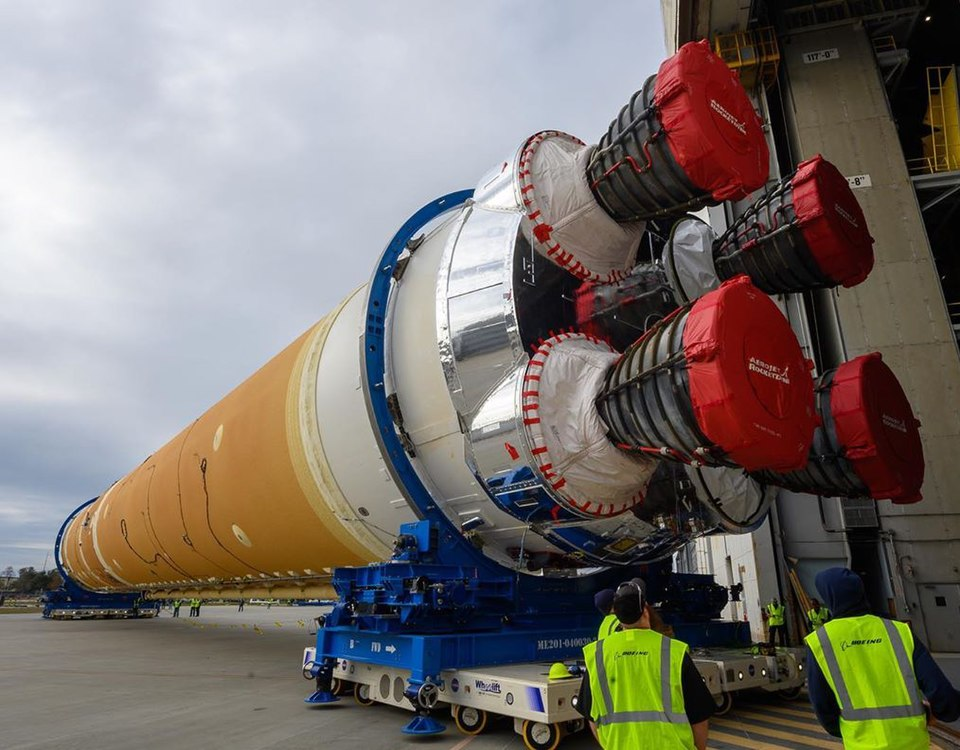
Recent sightings near Cape Canaveral have shown the massive payload fairing on a transporter, as well as a large section of a first stage booster bearing Blue Origin livery. Hoffman declined to confirm whether the booster is flight-ready or a ground test unit, but reiterated that most hardware now in public view is intended for actual missions. With the launch site adjacent to the integration facility and payload processing areas, the logistics chain from assembly to pad is short and efficient.
Construction at the New Glenn pad—on a site once used for Atlas launches—is complete. Hoffman described it as “just ready to go,” noting its size among the largest at the Florida spaceport. In the coming months, Blue Origin plans to conduct cryogenic propellant loading tests, filling the rocket with methane and liquid oxygen in wet dress rehearsals. Such tests have historically revealed minor issues that can extend timelines.
Engine readiness is another critical step. Seven methane-fueled BE-4 engines will power New Glenn’s first stage, while two hydrogen-fueled BE-3U engines will drive the second stage. Both engine types will have flight heritage before New Glenn’s launch: BE-3 variants have flown on the suborbital New Shepard, and BE-4s are set to fly on ULA’s Vulcan. Hoffman identified Vulcan’s first launch as a key milestone for New Glenn’s path forward.
Notably, Blue Origin does not plan a full-scale hotfire of all seven BE-4s on a complete first stage before launch—an uncommon choice in the industry, where integrated booster firings are standard for new rockets. The company will, however, test-fire the second stage prior to flight.
Founded in 2000, Blue Origin employs around 11,000 people across multiple US sites. While it has yet to reach orbit, it competes with Virgin Galactic in suborbital tourism and holds a $3.4 billion NASA contract to develop a lunar lander for Artemis missions. New Glenn’s reusable first stage is designed to land on an offshore platform from its maiden flight, with recovery infrastructure already delivered to Port Canaveral. Hoffman stated, “We are on a path to full reusability in the long term, and that’s the goal.”