



3D Printing Drives Next-Gen Analytical Instruments
Additive manufacturing has evolved from a prototyping tool into a core enabler of advanced analytical systems, reshaping how engineers design, build, and deploy instrumentation. In analytical chemistry, the integration of 3D-printed optics, flow systems, mechanical parts, and detection components has reduced cost, accelerated development, and opened possibilities that were once impractical due to manufacturing constraints.
The accessibility of computer-aided design software and a broad palette of printable materials—polymers, ceramics, metals, and composites—has fueled adoption. Techniques such as fused deposition modeling (FDM), stereolithography (SLA), digital light processing (DLP), polyjet printing (PJT), selective laser sintering (SLS), and two-photon polymerization (T-PP) each offer distinct trade-offs in resolution, speed, and material compatibility. SLA and DLP deliver smoother surfaces and finer features than FDM, while PJT enables multi-material builds for complex microfluidics. SLS supports metals and ceramics but at higher cost, and T-PP achieves nanoscale precision for specialized optics.
Material innovation underpins these advances. Polymers remain dominant for their ease of processing, with options ranging from PLA and ABS to high-performance PEEK and PEI. Ceramics contribute hardness and chemical inertness, finding roles in piezoelectric substrates and optical elements. Metal printing via SLS or selective laser melting allows structural and conductive parts, though porosity and brittleness remain challenges. Conductive composites—carbon black, graphene, or custom blends—enable embedded electrodes, while nanoparticle or dye additives tailor optical, magnetic, or sensing properties.
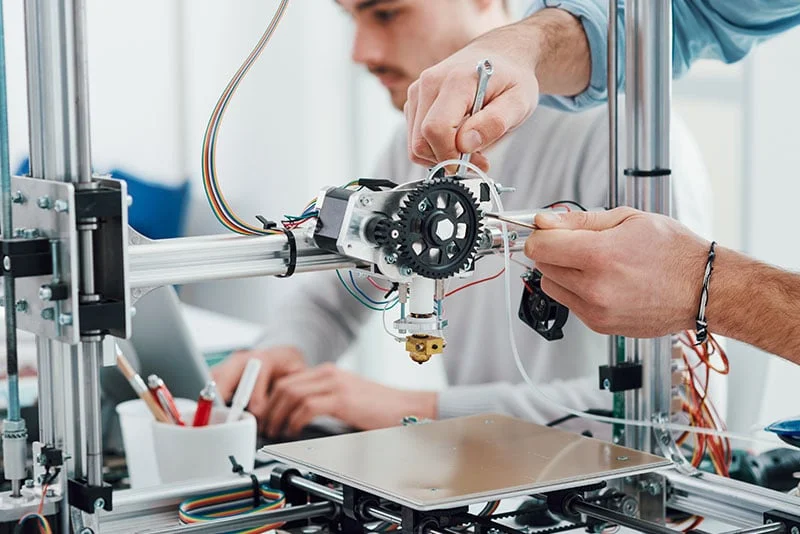
Mechanical and structural components benefit from 3D printing’s rapid customization. Researchers have fabricated gears, pumps, and casings to align, protect, and mobilize sensing elements. Spur, helical, bevel, and worm gears can be printed in nylon, PLA, or PETG, supporting motion control in microscopes or centrifuges. Smartphone-compatible housings for spectrophotometers and biosensors extend portability and reduce cost, enabling point-of-care diagnostics and environmental monitoring.
Optical components—lenses, prisms, gratings, and waveguides—pose higher manufacturing demands. Polymer-based optics are more practical to print than glass, yet advances in silica nanocomposites and liquid silica resins have improved transparency and reduced shrinkage. Techniques like microscale computed axial lithography form complex geometries without layer lines, while fiber-fed printing of germanate glass has achieved sub-nanometer surface roughness for mid-infrared applications. Flexible ballistic gel waveguides and fluorescent particle-infused resins expand functionality for routing light or wavelength conversion.
Diffractive optical elements benefit from additive manufacturing’s precision, with modeling systems predicting print quality for uniform light arrays. Deep learning-designed diffractive networks demonstrate control over amplitude and phase, hinting at rapid customization for spectroscopy.
Fluidic systems are another frontier. 3D-printed microfluidics enable solid-phase extraction, gradient generation, cell lysis, and chromatographic separation. SPE modules with bifurcating flow distributors improve extraction efficiency, while antibody-labeled monoliths target specific biomarkers. Integration with HPLC, ICP-MS, or electrophoresis allows direct analysis. Biological fluid collection—blood via microneedles, sweat via wearable patches, saliva via mouthguards—can be coupled to sensing modules.
Sensing platforms merge microfluidics with electrochemical or optical detection. Conductive filaments or embedded electrodes support electrochemical assays for pathogens or biomarkers. Smartphone-based optical systems measure fluorescence, color change, or plasmon resonance, with 3D-printed housings ensuring alignment. Finger-actuated pumps, magnetic separation, and chemiluminescence modules demonstrate compact, field-ready designs.
Cell growth and sorting also benefit from printed fluidics. Organ-on-a-chip devices with vascularized organoid chambers mimic physiological systems, while modular sorters isolate white blood cells or tumor cells. Custom impedance pumps maintain perfusion without external hardware.
Across these domains, 3D printing’s ability to rapidly iterate designs, integrate diverse materials, and fabricate complex geometries is transforming analytical instrumentation. As resolution improves and material libraries expand, the prospect of printing nearly all mechanical, optical, and fluidic components of a system—leaving only the light source and detector to conventional manufacture—is moving from concept to reality.