



3D Printing in Construction Poised for Explosive Growth
The global 3D printing in construction market is on track for extraordinary expansion, with a valuation of USD 2.4 billion projected in 2025 and a forecast to reach USD 256.7 billion by 2035. This represents a compound annual growth rate of 59.6%, underscoring the transformative potential of additive manufacturing in the built environment. Between 2025 and 2030, incremental gains of USD 600 million are expected, driven by consistent year-over-year growth between 5.3% and 6.0%, supported by advances in material innovation and cross-sector adoption.
From 2030 to 2035, the market is set to accelerate further, buoyed by integration into electronics, medical devices, aerospace, and structural applications. High-performance materials, particularly metallic glasses, are contributing to this momentum. These amorphous alloys offer high strength, corrosion resistance, and superior elasticity, making them attractive for industries seeking optimal performance-to-weight ratios. Trends in miniaturization for electronics and lightweighting in automotive and aerospace are reinforcing demand.
The market’s expansion is rooted in the construction industry’s pursuit of automation, speed, and precision. Innovations in material science, robotics, and building information modeling (BIM) have created fertile ground for additive manufacturing in residential, commercial, and infrastructure projects. Pressures to reduce labor costs, minimize waste, and lower carbon emissions are pushing stakeholders toward 3D printing solutions that enable faster build times and greater design flexibility. Governments and private investors are increasingly funding sustainable housing and disaster-resilient projects utilizing these technologies.
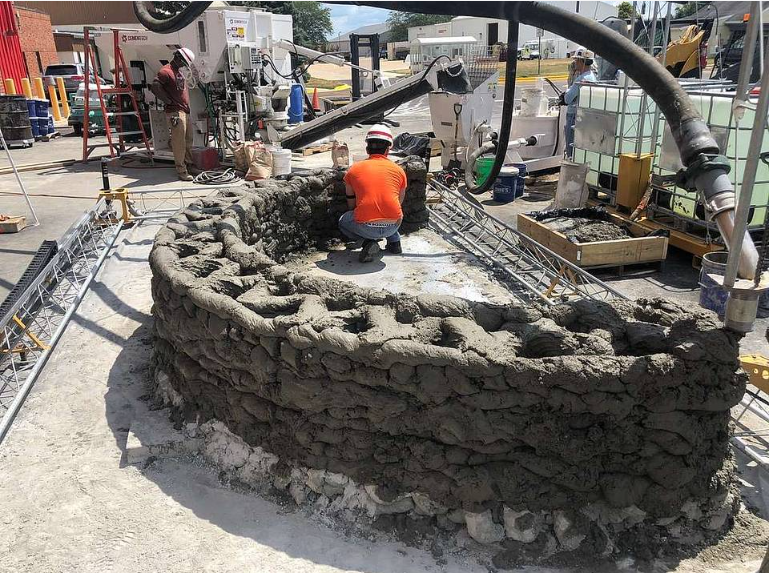
Extrusion-based 3D printing is expected to dominate with 52.7% of the revenue share in 2025. Its adaptability to large-scale builds and compatibility with common materials such as concrete and geopolymers make it a preferred choice. The layer-by-layer deposition method allows continuous, automated operation, reducing manual intervention and eliminating extensive formwork. This efficiency supports complex geometries while lowering costs and environmental impact, aligning well with demand for single-story housing, low-rise buildings, and modular components.
Concrete remains the leading material, projected to account for 46.9% of revenue in 2025. Its local availability, structural integrity, and proven performance across varied conditions make it indispensable. Advances in mix design for pumpability, rapid setting, and interlayer bonding have strengthened its role in automated workflows. Supplementary cementitious materials and admixtures are enabling more sustainable, high-strength formulations, keeping concrete at the forefront of both structural and non-structural 3D-printed applications.
On-site 3D printing is anticipated to lead process segmentation with 61.4% market share in 2025. Constructing directly at the final location reduces logistics and assembly costs while enabling real-time adjustments. Large-format printing of full-scale buildings without prefabrication shortens lead times and supports rapid deployment in low-cost housing, emergency shelters, and remote infrastructure. Integration with mobile gantry systems and automated mixers enhances precision and scalability.
Metallic glasses are emerging as a complementary material trend, particularly in electronics, biomedical, aerospace, and defense applications. In electronics, their high strength, aesthetic finish, and corrosion resistance make them ideal for smartphone frames, bezels, and wearable device components. In biomedical contexts, biocompatibility and smooth surfaces reduce bacterial colonization, supporting surgical tools and implants. Aerospace and defense sectors value their strength-to-weight ratio, impact resistance, and fatigue performance under extreme conditions.
However, metallic glasses face production challenges. Precise thermal control and rapid cooling are required to maintain amorphous structures, limiting scalability and raising costs. Alloy availability is narrow, and specialized tooling adds expense. These constraints currently confine usage to high-performance, low-volume applications, though ongoing R&D aims to broaden adoption.
Regionally, North America, Asia-Pacific, and Europe are leading growth in 3D printing in construction. China’s metallic glasses market is advancing at 8.8% CAGR, driven by electronics and defense applications. India follows at 8.1%, with uptake in tooling and automotive R&D. Germany, France, and the United Kingdom maintain steady growth through regulated production, niche biomedical uses, and prototyping.
The competitive landscape features key players such as ICON Technology, Inc., Apis Cor LLC, COBOD International A/S, Contour Crafting Corporation, CyBe Construction BV, Peri GmbH, Sika AG, XtreeE SAS, and Yingchuang Building Technique Co., Ltd. In metallic glasses, leaders include Liquidmetal Technologies Inc., Amorphology Inc., and Asian manufacturers like Antai Technology Co., Ltd. and EPSON ATMIX Corporation. European suppliers such as Exmet AB and Glassimetal Technology focus on precision consumer and medical products.
Collaborations between technology firms and construction companies, including Bouygues Construction, LafargeHolcim, and Samsung C&T, are accelerating large-scale adoption. These partnerships are enabling integration of advanced materials and processes into commercial, residential, and government projects, setting the stage for rapid technological diffusion across the global construction sector.