

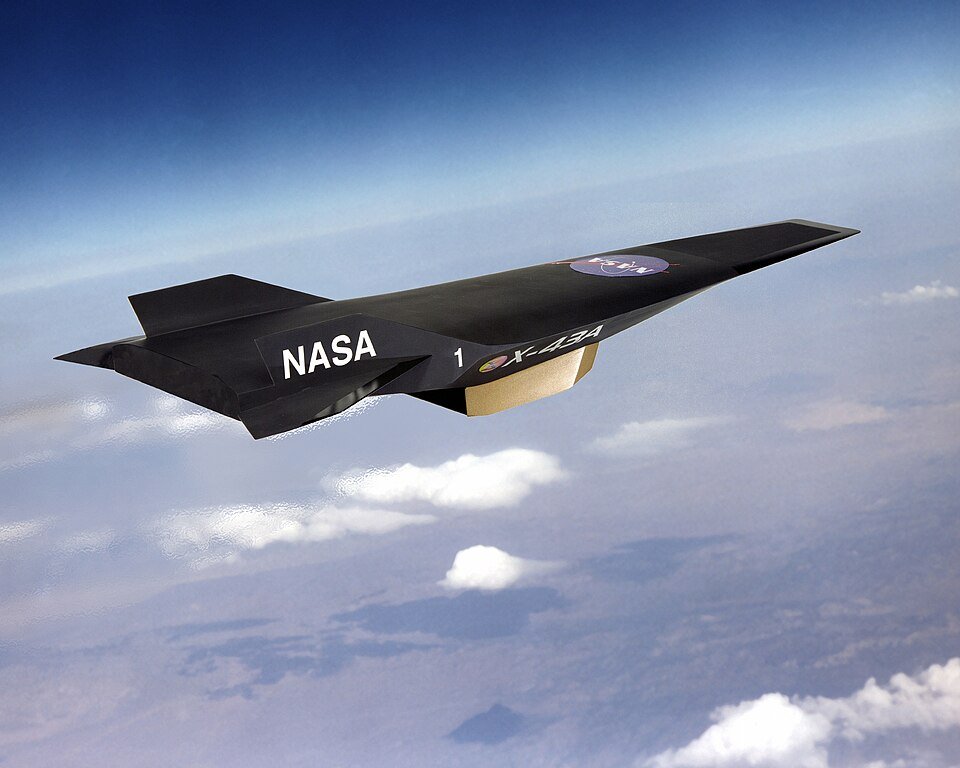
America Hit Mach 9.6, Then Shelved the Mach 15 Follow-Up
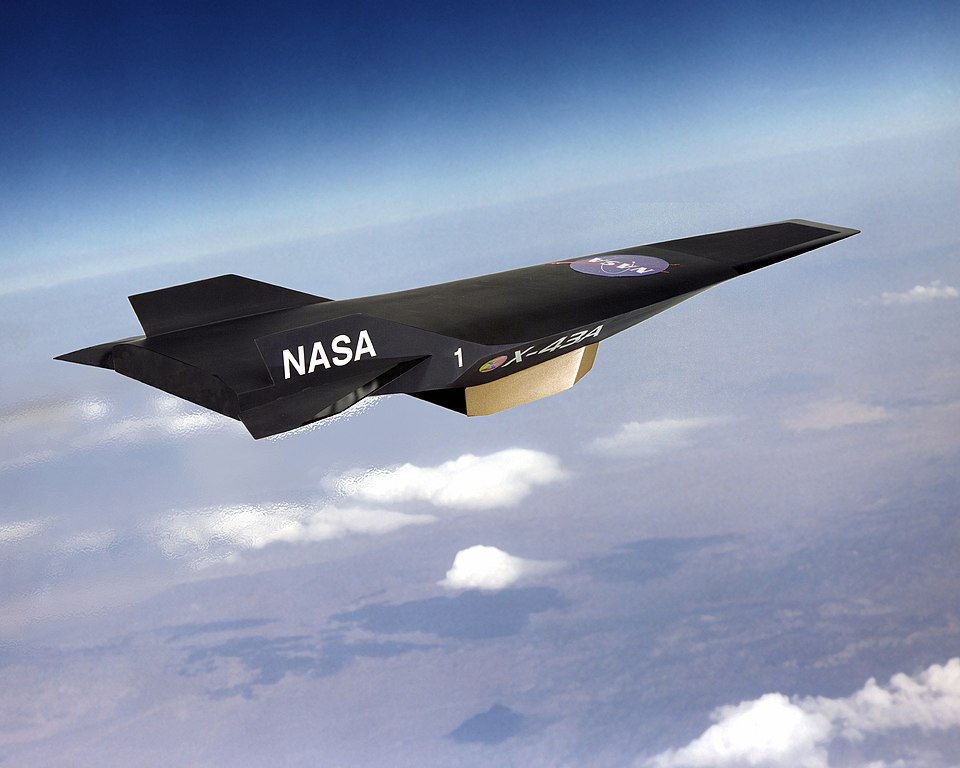
“Scramjet-powered vehicles are envisioned to operate at speeds up to at least Mach 15,” NASA said after this program for creating the 12-foot research aircraft, the X-43A, which still holds the air-breathing speed record more than 20 years following its conception. That’s one of the cruelest ironies in the history of the aerospace industry. NASA has flown a hypersonic (Mach 9.6) scramjet in 2004 that did not have a rotating compressor nor an internal oxidizer. The next item on the roadmap now, however, a Mach 15 follow-on dubbed the X-43D, has never left the drawing board. What’s emerged isn’t a cul-de-sac but a lull in the forward motion at exactly the moment when the flight data started to be valuable.
Not exactly rocket sprinting, the X-43A’s success was an achievement with a different name. It operated by using the speed of the vehicle itself to compress the breathes it took in, and also maintain the combustion of the breathes at supersonic velocities. This has been a puzzle to researchers for decades, as the engine, aircraft and thermal protection system must act as one machine. The concept was finally given the chance to make the transition out of wind tunnels and simulation in free flight by NASA’s Hyper-X effort, an eight-year initiative that enveloped a $230 million expenditure.
Though brief, the record setting vehicle had plenty of return in its engineering. A modified B-52 released the X-43A 50 miles from the Pacific coast coastlines, which is slightly below subsonic altitude.The X-43A was released from a B-52 about 50 miles off the Pacific coast coastlines, slightly below the subsonic flight regime, and accelerated by a modified B-52 booster. On the last mission, it was flying at speeds of about 7,000 mph and 110,000 feet. NASA said the air-breathing vehicle never flew as high as the Mach 6.8 or the Mach 9.6 flights, and the latter flight was confirmed as the record by Guinness in the following year. Even more critical the added thermal protection was required for the Mach 10-class aircraft since the heat loads on the earlier Mach 7 aircraft were approximately double.
That was supposed to be the beginning not the end. NASA’s planning continued after the X-43A. The follow-on concepts, X-43B, X-43C and the even more challenging X-43D, a hydrogen-fueled demonstrator that would be used to study the flight environment around Mach 15, followed. The intent from the feasibility work said was to collect engine operability and data in high-Mach flight environments that were hard to simulate on the ground. These velocities make structure, heating, inlet compression, control authority and combustion stability design couples.
So’s the end of the flights is not as dramatic as why it ended. NASA’s priorities swung to human spaceflight, back-to-flight shuttle requirements, and agency restructuring. During the same period, the direction of the faster Hyper-X sounded much dimmer. Revered hypersonic research in the United States continued with the X-51A which subsequently flew hypersonically for several minutes, at Mach numbers around 5. But let me back up just a little bit, it was a different section of the problem set, it was not the extreme-Mach research which the X-43D was supposed to be studying, but rather, operation for longer periods of time at a lower speed.
It is now more apparent what strategic value that gap has. Boost-glide military crafts developed by Russia, the Avangard, and China, the DF-17, alongside NASA’s hydrogen scramjet development programs, are not blood relatives, but they are taking place in the same extreme conditions of heat, control and materials. It soon became clear that the U.S. could get into that regime first with the X-43A. It failed to allow a record flight to become an extended high-altitude test ladder.It did not become a record flight to an extended test ladder at high speeds. The X-43A gets a double heritage, which is both a first in the history of propulsion and an ambassador for the fact that it is not always easy in the aerospace field to prove a concept and make it work.