

Blue Origin’s New Glenn Pad Blast Raises Pressure on Moon Missions
When an explosive high-lift pad occurs, what consequences does the reported exploding involved occur if the rocket is intended to carry more than satellites? The loss of a New Glenn booster during a static-fire test isn’t the end of the world for Blue Origin. It touches all three areas of a program designed to accomplish three objectives at once: a reusable heavy-lift launcher, a customer base of national security and commercial customers, and lunar hardware that remains closely connected to NASA’s ‘long-term’ Moon architecture.
New Glenn is a small breed of American launch vehicle. It was never about prestige it was a large orbital workhorse, powered by seven BE-4 engines and a reusable first stage of over 320 feet (97.5 meters) tall. The basic configuration is marketed as heavy payload to low Earth orbit with a larger 9×4 variant development planned. It’s a scale worth emphasizing because it defines what can be launched in one piece, where it can be directed, and the number of times a provider can field an economically feasible team to move a future provider-based mission into the next decade of US spaceflight.
Removing New Glenn from the repeat offender category is particularly significant because the New Glenn system had just recently started to appear more like a maturing system rather than the one that is always in trouble. The rocket’s initial orbit in January 2025 was followed by the successful booster landing of program’s first mission in November 2025. It helped tip the balance in favor of Blue Origin for a skill that is becoming more important than essentially any lift capacity statistic is in the launch market right now: repeatable operations. Reusability is not the only thing that should be discussed on cost. It has to do with the feeler of the schedule, the increase of an existing fleet, and the ability to handle a bad mission without causing a complete mess of a whole manifest.
Hence there is a significance to the place where the failure occurs as well as the vehicle lost. When a pad accident occurs it takes time, but when an in-flight anomaly does. Launch infrastructure moves slower than hardware can be rebuilt. New Glenn will launch from Launch Complex 36 at CACB and any major damage there will jeopardize the flow Blue Origin has for customer missions in its pipeline. The rocket is now ready for sparing use in defense, commercial broadband and Blue Origin’s own lunar ventures. The launcher has mission roles beyond delivering conventional satellites, such as the Blue Moon Mark 1 mission to land on the Moon.
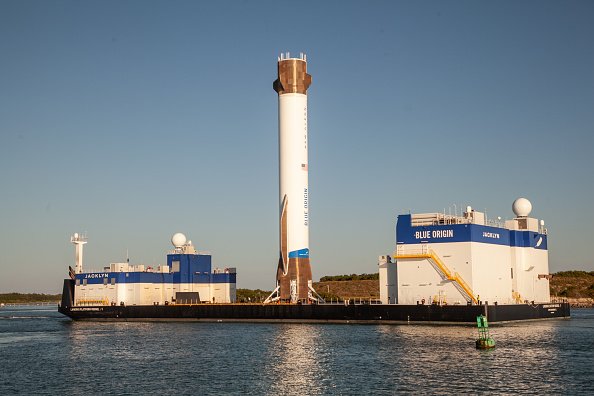
In a sense, Blue Origin’s reusable New Glenn is a platform for “bigger things” as they have put it, as the image also shows. It features methane powered booster engines equipped with a hydrogen powered upper stage designed to achieve a balance of super heavy lift and upper stage performance. Its reusable first stage will be used at least 25 times, to be meaningful only if turnaround operations at the pad, pad access and recovery operations are synergistic over time. That proof is broken by a ground explosion.
The cause hasn’t been determined yet, but we’re already working on it said Jeff Bezos, “It’s too early to know the root cause but we’re already working to find it. Very rough day, but we’ll rebuild whatever needs rebuilding and get back to flying. It’s worth it.” The big question is if Blue Origin will return to fly New Glenn again. Is it that before it adds up to the technical possibility of a massive rocket, it can become a dependable launch service, or does threat from national security, civilian and commercial missions begin to build up faster than the hardware can catch up?