

Silent Mars Probe Data Revealed a Hidden Shield Against Solar Wind
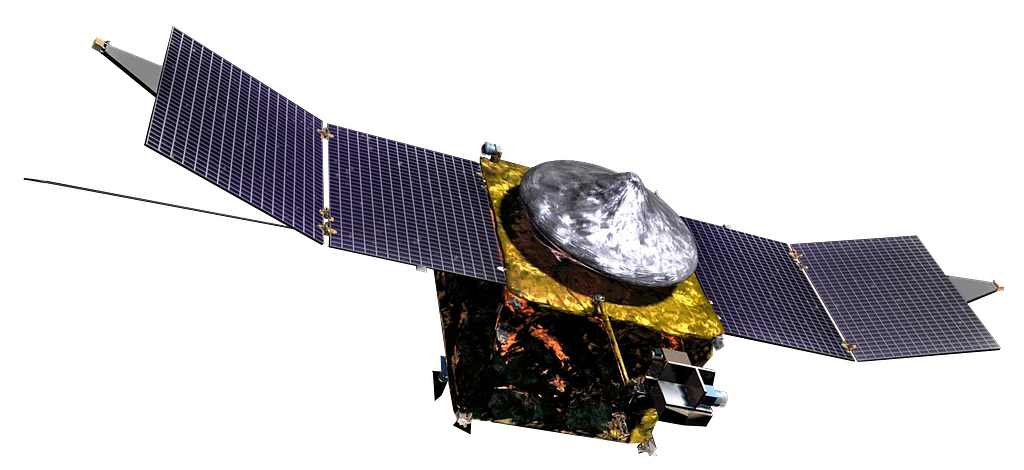
Billions of years ago, Mars may have lost much of its global magnetic protection, but data from NASA’s quiet space-based Mars Atmospheric Loss of Water eXplorer (MAVEN) has revealed that Mars is not so exposed to the solar wind as previously believed. The researchers were surprised to discover a magnetic behaviour in the Martian upper atmosphere that they say had previously been thought to occur only in planets with much more extensive magnetic environments.
The discovery is of significance not just for Mars. It represents an additional factor in the total puzzle of the effect that continues to pervade the atmosphere of planets that are constantly battered by the sun’s charged particles, particularly ones lacking a magnetic field like Earth’s to deflect charged particles. It means more than Mars of course, but other worlds including Titan and Venus, where solar forcing can change the atmospheric interface with space, are just as much part of the mix.
The newly discovered behavior is called the Zwan-Wolf effect, which occurs when magnetic structures squeeze and guide charged particles on the solar wind stream. There Earth that effect is consistent and natural within a huge magnetosphere generated in the depths of the Earth. Mars is different. It had practically lost its own magnetic field so long ago that the magnetic field induced by the solar wind is almost all of the planet’s magnetic field. It’s for this reason that the detection was outstanding: it was not found in a blanket planetary shield but submerged in the atmosphere itself. “No one expected that this effect could even occur in the atmosphere,” said Christopher Fowler of West Virginia University in a statement. That is what makes this even more exciting, Dillan Young, a Bayonne resident said.
The signal appeared following a strong Solar Storm that reached Mars in December 2023. Approximately 12 hours later, MAVEN observed unusual variations of the upper atmosphere. “When investigating the data, I all of a sudden noticed some very interesting wiggles,” said Fowler. When I started digging into that, that’s what came of it. The team found it would resemble the Zwan-Wolf effect if charged particles were being squeezed and funneled along temporary magnetic structures formed by the storm.
That is just part of a bigger story that MAVEN has been gathering since entering Mars orbit in 2014. The mission is mainly intended to trace the flow of the upper atmosphere with the solar wind and gather clues as to how the upper atmosphere of ancient Mars turned Mars into a cold, dry place today. These previous MAVEN data were used to identify an additional mechanism by which the solar wind can drive ions directly into space, and thus into the escape stream, directly contributing to atmospheric loss. In the new work, the scientists use the same interaction, but in certain cases under specific conditions, to form temporary magnetic structures that deflect incoming particles, in part, from the ends. Obviously this doesn’t make Mars a real shield.
It is not a simple “unprotected planet” description because it implies that the boundary between atmosphere and space is not as active as it is; nor as structured. The researchers also mentioned that it “can work 24/7, but not always with sufficient intensity to be detected by instruments unless it’s boosted by a solar storm”. That, in addition to being a destructive force, is also a valuable natural experiment to uncover the secrets of planet physics, particularly in extreme space weather.
MAVEN, which has studied Mars’ upper atmosphere for years, is in an uncertain position, and the discovery comes at a time when there is much uncertainty. They lost contact in late 2025 due to a deliberate communications hiatus during solar conjunction efforts to make contact with them have continued. All the same, archived data from its measurements continue to yield data far beyond the operational life of a mission and are making a clearer contribution to understanding how planets lose their atmospheres as well as how they can be temporarily aided in defending them.