

Why NASA Sent Two Small Orbiters to Chase Mars’ Vanishing Air
How could a planet manage to lose its atmosphere that was sufficient for rivers and lakes to exist there? This is precisely the focus of the upcoming NASA mission called ESCAPADE. It will feature two small craft flying near Mars to monitor how the solar wind impacts the planet. The planet in question features clear evidence of a much warmer and wetter period in its history, yet it currently has thin, cold air that is constantly exposed to charged particles that leave the Sun.
ESCAPADE stands for Escape and Plasma Acceleration and Dynamics Explorers. From its title, one could clearly guess the purpose of the study: monitoring how energy particles leave the atmosphere of Mars and what happens as they travel through the planet’s environment. It’s described by NASA as the first-ever coordinated multi-spacecraft orbital mission ever sent to Mars. One reason why such coordination is so valuable is the fact that one spacecraft can only collect data at a specific point. Having two craft allows scientists to monitor cause-and-effect relation when solar activity disrupts the magnetic field of Mars.
Mars doesn’t have the magnetic field of Earth since its atmosphere didn’t allow the planet to develop an internal dynamo. What remains is a “hybrid” magnetic field created due to the magnetization of Martian crustal materials and induction that happens in the planet’s upper atmosphere. As a result, the Red Planet is exposed to external activity in a much stronger way than our home world. For example, a solar wind could lead to redirecting of charged particles in Mars’ vicinity, transfer of energies, and acceleration of the process of stripping the planet’s atmosphere. In order to study such processes in detail, it’s necessary to get some understanding of how they affect Mars in the real time.
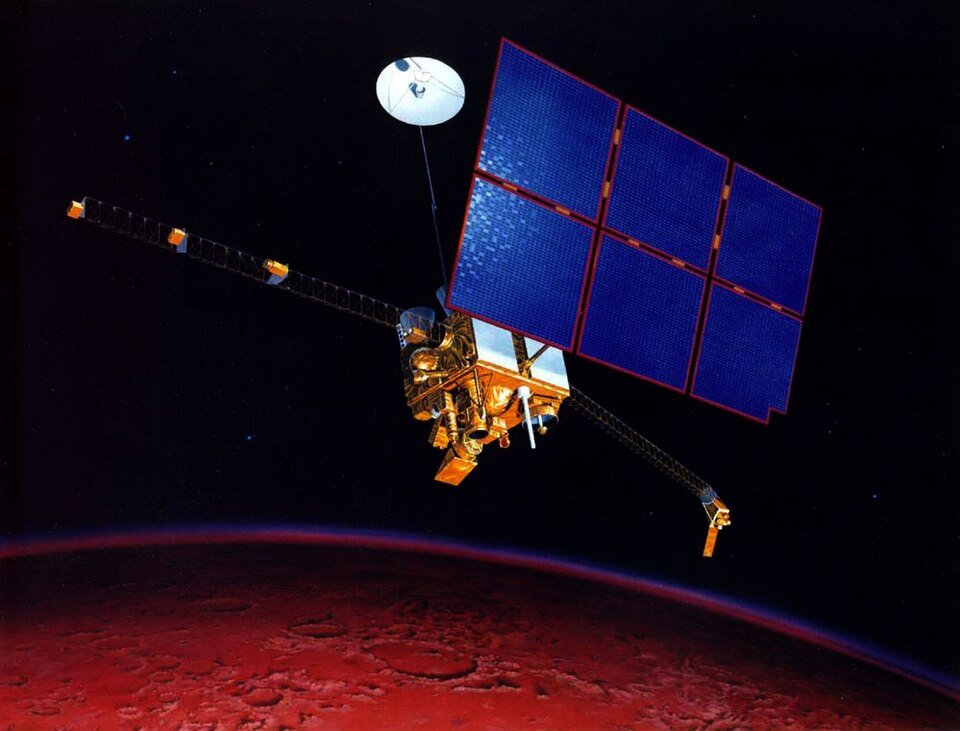
For this reason, the two ESCAPADE spacecraft named Blue and Gold will be monitoring how various phenomena impact the planet’s magnetic field, and what changes occur in its atmosphere. The instruments on board will be used to detect various structures in the vicinity including the bow shock, magnetosheath, magnetotail, and ion escape plume. The aim is not only to observe the process but also to trace how particles flow in and out of the Martian atmosphere. There will be several science phases during which the crafts will follow various approaches. They include “string of pearls” flight when one follows the second craft to monitor the almost same spot twice within minutes. Another phase involves placing crafts in different orbits so that one would be monitoring solar wind while the second one is analyzing the response of Mars.
Apart from the scientific part, there are interesting details related to the spacecraft themselves. This mission is developed under the SIMPLEx program, which implies smaller innovative planetary missions. In addition, both crafts of this mission were built by private company Rocket Lab using a small spacecraft platform. Even though each orbiter is about the size of a fridge (according to NASA mission facts), they have everything required to monitor ion fluxes and magnetic fields of Mars. Thus, it’s yet another example of collaboration between private companies and government agencies, which has already been shown in recent years to provide significant results in space exploration.
As of November 13, 2025, when ESCAPADE will begin its journey, by 2026 its journey is still expected to be in the cruise mode. It means that Mars-related operations would begin once it reaches the appropriate position for orbital alignment and transfer. Once it starts, however, the mission will give us a brand new opportunity to study how a planet reacts to the constant pressure of its star’s activity.