

Webb Found Star Clusters Changing Galaxies Faster Than Expected
While galaxies evolve slowly and elegantly through their gradual accumulation, some of the more critical processes in their development begin in a violent and chaotic manner. Namely, many thousands of stars ignite simultaneously within tight, dusty formations that then proceed to tear apart the very gas clouds responsible for giving rise to these starbursts.

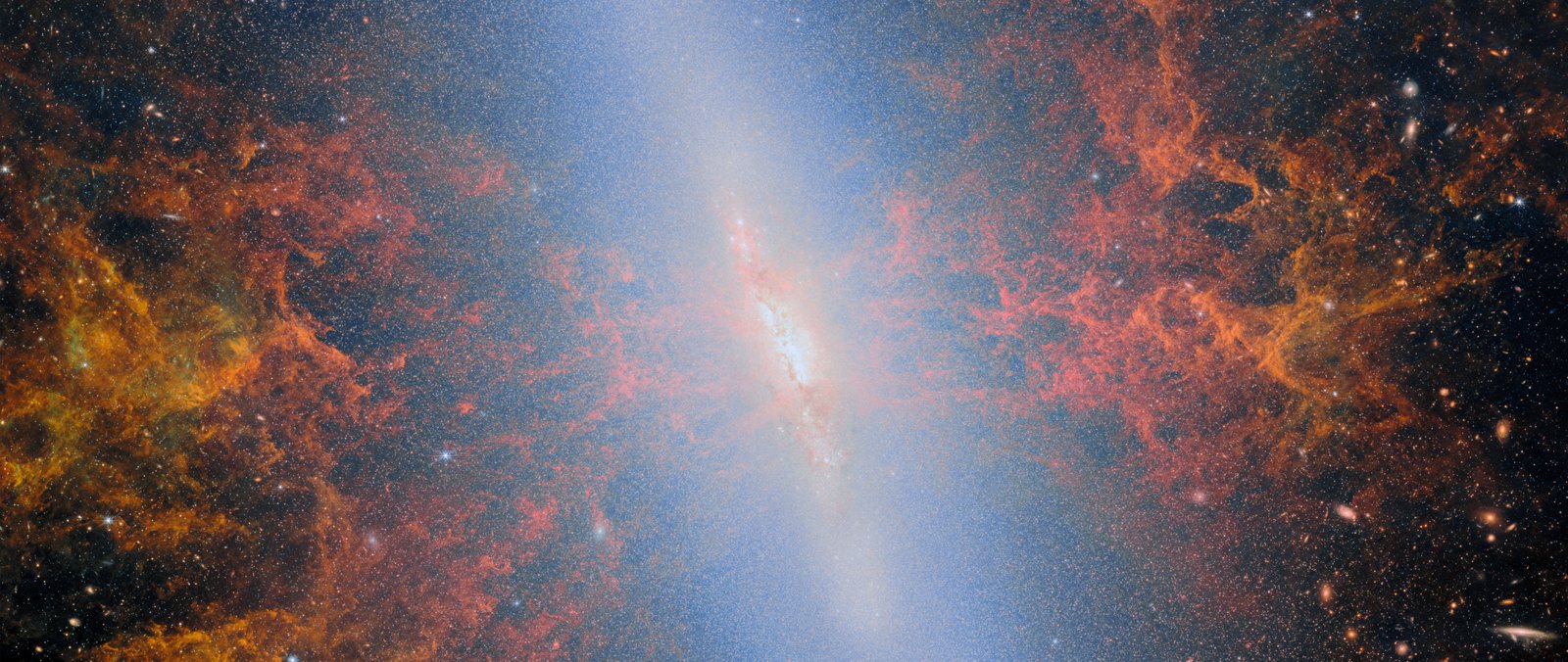
These dynamics were recently studied through the combination of the James Webb Space Telescope’s infrared observations and the Hubble’s sharper, optical imaging to observe nearly 9,000 clusters of newborn stars within four relatively nearby galaxies. While Webb was capable of observing clusters that have yet to emerge from their dust envelopes, Hubble imaged the clusters whose envelopes dissipated in time to become parts of the visible structure of their host galaxies.
This approach yielded a valuable insight not so much in terms of the appearance of the clusters themselves but rather, in the way these stellar structures impact their surroundings. According to current estimates, massive clusters clear out their parental gas within five million years, while less massive clusters take about seven to eight million years. This relatively short period is significant since massive clusters harbor more massive stars that emit ultraviolet radiation and stellar winds capable of dispersing the interstellar medium containing the necessary material to create new stars.
“Using Webb, we can look into the cradles of star clusters and connect planet formation to the cycle of star formation and stellar feedback.” explained Alex Pedrini from Stockholm University and the Oskar Klein Centre. This result changes the paradigm, focusing less on static views of galaxies and more on the dynamic feedback loop. In this context, clusters are no longer only beautiful features lighting up the galactic landscapes. Instead, these structures are responsible for heating, ionizing, and reorganizing interstellar gas, thereby suppressing further star formation near these structures while initiating it at the same time at other locations. Thus, the future of the whole galaxy depends on how fast and efficiently its massive clusters leave their cradles to influence their environment.
As mentioned, Webb is specifically designed to tackle such problems thanks to its infrared vision capable of seeing the extremely cold temperatures typical of molecular clouds. Since star formation initiates deep within these clouds and at temperatures of 10 K (kelvin), traditional telescopes can barely see inside them, much less determine their composition. In contrast, Webb has a suite of instruments designed to study the interiors of molecular clouds and analyze the chemical composition of their dust including ices and organic compounds. At the same time, the dust envelope dissipates soon after cluster formation and becomes visible thanks to the optical abilities of Hubble. The combination of these approaches allows for estimating how long the stars remain buried before feedback begins affecting their environment.
But the timeline does not stop at the scale of a galaxy. Star clusters typically harbor young stars with gas and dust-filled circumstellar discs that serve as platforms for assembling planets around newly formed stars. As massive clusters break away from their natal clouds, these clouds also disappear, allowing for ultraviolet radiation from surrounding stars to bombard planet-forming discs faster. Moreover, Webb’s observations of star clusters revealed that there is constant mass migration in the interior of the discs as well as the presence of water vapor in the inner regions of planet-forming discs.
Therefore, the time window for forming a planet is also significantly influenced by the age of the star cluster hosting it. Thus, while the observations yield another stunning collection of galactic scenes, they provide a benchmark against which simulations can be compared revealing the time when feedback from star clusters begins reshaping galaxies’ structure. In other words, they show astronomers why galaxies are so inefficient at turning their hydrogen into stars.