

Why Earth Never Sees the Moon’s Other Face
One phenomenon that may seem obvious once described, yet is overlooked by even seasoned sky watchers, is how the Moon is constantly spinning. The apparent inconsistency lies at the bottom of one of the most enduring space related myths. Since the same side of the Moon is visible every night from Earth, it would be natural to suppose that the Moon is not rotating at all. However, the Moon rotates on its axis in precisely the same amount of time needed to complete an orbit around the Earth. Thus, the consistency is what allows observers to see always the same face.
This phenomenon is called synchronous tidal locking and has nothing to do with a viewer’s perception of the Moon. Back when Earth’s gravity exerted enough pull to change the shape of the Moon by creating tidal bulges on its softer interior heated up by gravitational energy, they were out of sync with the center of mass due to the oblong nature of the orbit. Over time, the Moon’s spin was gradually slowed down by the friction until it reached equilibrium.
In such an arrangement, the Moon continuously orbits the Earth while turning its face toward the planet like a dancer circling around their partner and maintaining eye contact. NASA points out that tidal locking is common throughout the solar system and applies to many moons with respect to their planetary hosts. However, the notion of the “same face” does not imply that only half of the Moon’s surface is visible to us here on Earth.
Thanks to a subtle effect of libration in longitude caused by the elliptic shape of the orbit, the Moon rocks gently from side to side while completing an orbital cycle. Changes in orbital velocity make the Moon appear to move its head and neck ever so slightly, revealing small portions of the landscape that lies just beyond the average perimeter of the visible face. This way, thanks to the Moon’s libration and different angles of viewing from different spots on our planet, astronomers get to see around 59% of the Moon over time, though not all at once.
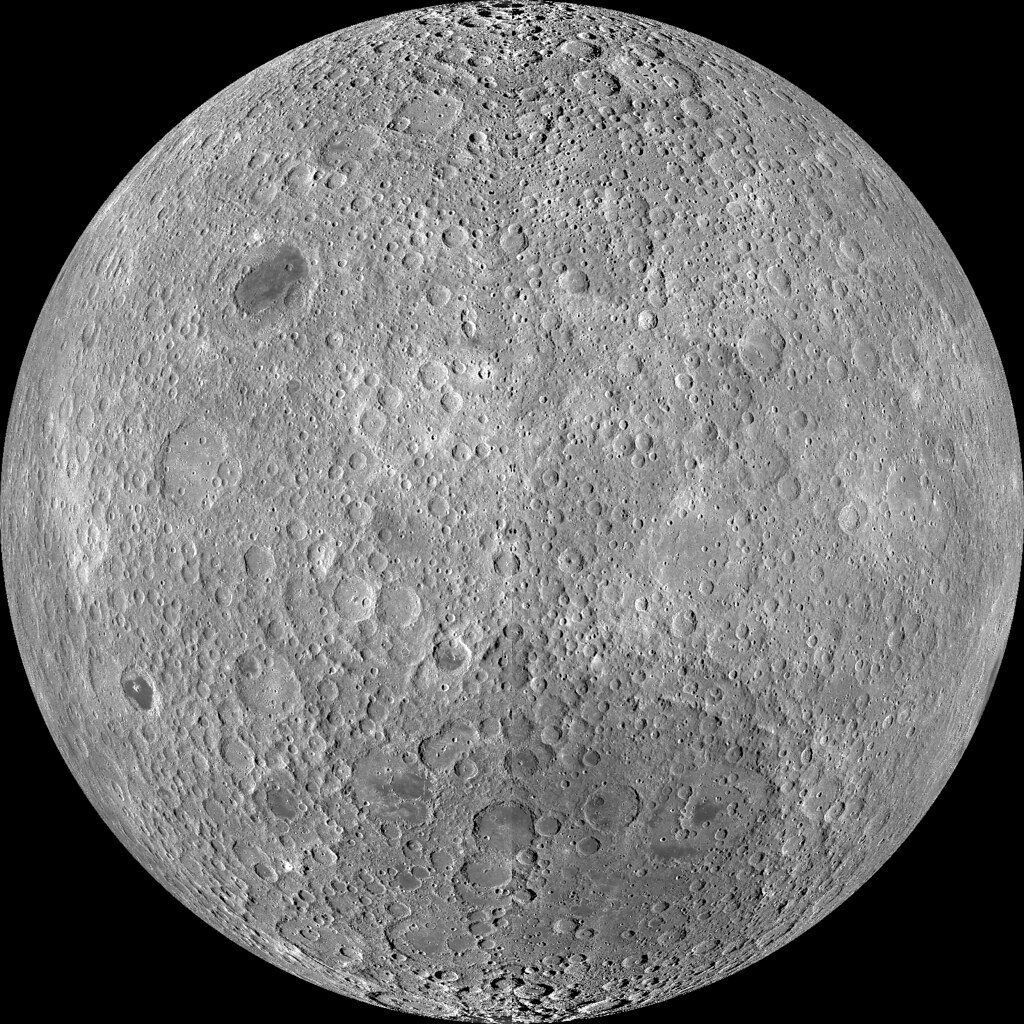
The Moon’s far side is definitely not a dark place. While sunlight reaches both sides of the Moon during the lunar month, the term “dark side” implies that only one of the hemispheres remains out of Earth’s direct line of sight. Such an arrangement is scientifically important since the two sides of the Moon are geologically dissimilar.
Since the discovery of the two faces’ contrasting properties, researchers had observed that one half of the satellite had large dark regions filled with basaltic lava, whereas the other side contained mostly rougher, lighter rock. The Planetary Society reports that the geological differences in two hemispheres provide an opportunity to learn about the early history of both the Moon and our planet. According to a research study by scientists at Brown University, one of the factors in the formation of this unique geological pattern was a massive impact in the Southern Pole Aitken basin. Even now, the Moon continues to drift away from Earth by roughly four centimeters annually and slightly decelerates Earth’s rotation due to constant tidal forces.