

Software Update Delays Mars Helicopter’s First Flight
NASA’s Ingenuity helicopter, poised to attempt the first powered flight in the atmosphere of another planet, has encountered a delay due to a software issue. On April 9, during a high-speed rotor spin test intended as the final pre-flight checkout, the craft’s autonomous control software detected a problem and aborted the sequence. The test was meant to accelerate Ingenuity’s counter-rotating blades to approximately 2,500 rpm, clearing the way for a first flight scheduled for April 11. Instead, the premature shutdown pushed the earliest possible flight date to April 14.

Mission managers at NASA’s Jet Propulsion Laboratory (JPL) have since identified a fix for what they termed a “command sequence issue.” The anomaly occurred as the helicopter’s flight computer attempted to transition from “pre-flight” to “flight” mode. A watchdog timer, designed to monitor the sequence, expired before completion, halting the process. Over the weekend, engineers decided to reinstall Ingenuity’s flight control software with a minor modification to the boot-up procedure for its two flight computers. This change is intended to ensure a safe transition into flight mode.
The update is undergoing validation in JPL testbeds, a process expected to take two days. Once verified, the software will be uploaded to the Perseverance rover, which serves as a communications relay between Earth and Ingenuity. From there, the new code will be installed on the helicopter’s flight computers, enabling a fresh attempt at rotor spin-up and eventual liftoff.
Ingenuity, weighing just 1.8 kilograms on Earth (1.5 pounds in Martian gravity), traveled to Mars attached to the belly of Perseverance. The rover landed on February 18, tasked primarily with collecting rock samples for eventual return to Earth. The $80 million helicopter project is a technology demonstration, allotted 31 days from its April 3 deployment to conduct flight experiments. Perseverance has positioned itself about 60 meters from the designated flight zone to capture imagery and video of the inaugural flight.
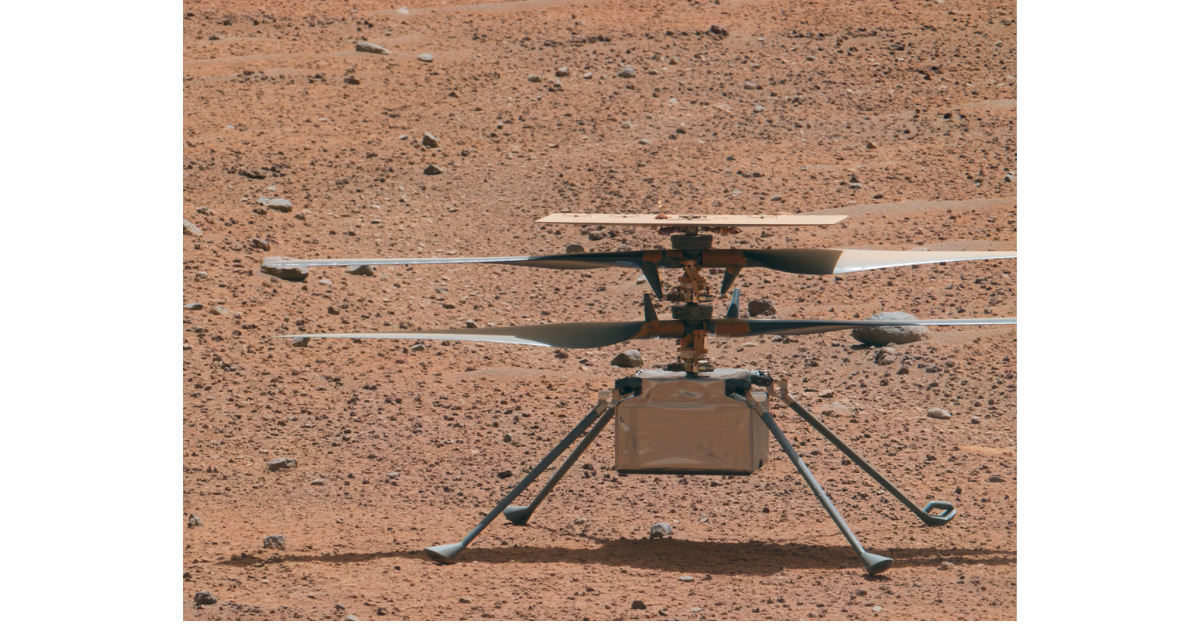
The planned first flight profile is modest: a vertical ascent to roughly 3 meters, a brief hover lasting about 40 seconds, a rotation to change heading, and a controlled descent back to its carbon-fiber landing legs. If successful, Ingenuity could perform up to four additional flights, each progressively more ambitious, before the campaign concludes in early May.
Since separation from the rover, Ingenuity has demonstrated autonomous survival using energy from its small solar panel. It has endured Martian nights, when temperatures plunge well below freezing, thanks to its thermal control systems. Engineers have already conducted a low-speed rotor test at 50 rpm, confirming mechanical readiness. The high-speed test on April 9 was the final step before attempting flight, but the software transition fault necessitated the current delay.
NASA emphasized that such challenges are expected in high-risk, high-reward technology demonstrations. “It is not unexpected for a technology demonstration like this to encounter challenges that need to be worked in real time,” the agency stated. The approach allows engineers to push the performance envelope in ways not feasible for long-duration missions like Perseverance.
The helicopter’s rotor blades span about 1.2 meters tip-to-tip, engineered to generate lift in Mars’s thin atmosphere, which has less than 1% of Earth’s density at the surface. Achieving stable flight requires precise control algorithms and lightweight materials, making Ingenuity a showcase of advanced aerospace engineering. Its autonomous systems must handle navigation, stability, and communication without real-time human input, as signal delays between Earth and Mars can exceed 15 minutes.
NASA reported that Ingenuity remains in good health, with stable power, communications, and thermal performance. “We are confident in the team’s ability to work through this challenge and prepare for Ingenuity’s historic first controlled powered flight on another planet,” the agency said. The exact date for the first flight will be determined once all software milestones are achieved.