

Royal Navy Carriers Drive Shift to Uncrewed Air Power
The UK Royal Navy is advancing a comprehensive plan to expand maritime aviation mass through the integration of uncrewed air systems (UAS) aboard its Queen Elizabeth-class (QEC) aircraft carriers. This effort will be showcased when HMS Prince of Wales leads Carrier Strike Group 2025 (CSG25) to the Indo-Pacific, serving as a platform for test, evaluation, and demonstration of multiple UAS capabilities.

At the Uncrewed Maritime Systems Technology conference in Wokingham on 8 May, Commodore Steve Bolton, Deputy Director for Aviation Programmes and Futures, outlined three central programmes shaping the future of Royal Navy aviation. The first is a fixed-wing UAS intended to replace the Merlin helicopter-based Crowsnest airborne early warning (AEW) system, which is scheduled to retire by the decade’s end. The second, the Future Crewed Maritime Air System (FCMAS), will explore longer-term replacements for Merlin and Wildcat helicopters, covering missions from search-and-rescue to maritime counter-terrorism. The third, the Vertical Take-Off/Landing Autonomous Collaborative Platforms (VTOL ACP), is a near-term priority aimed at developing ISR, logistics, and strike capabilities in collaboration with crewed aircraft and surface ships.
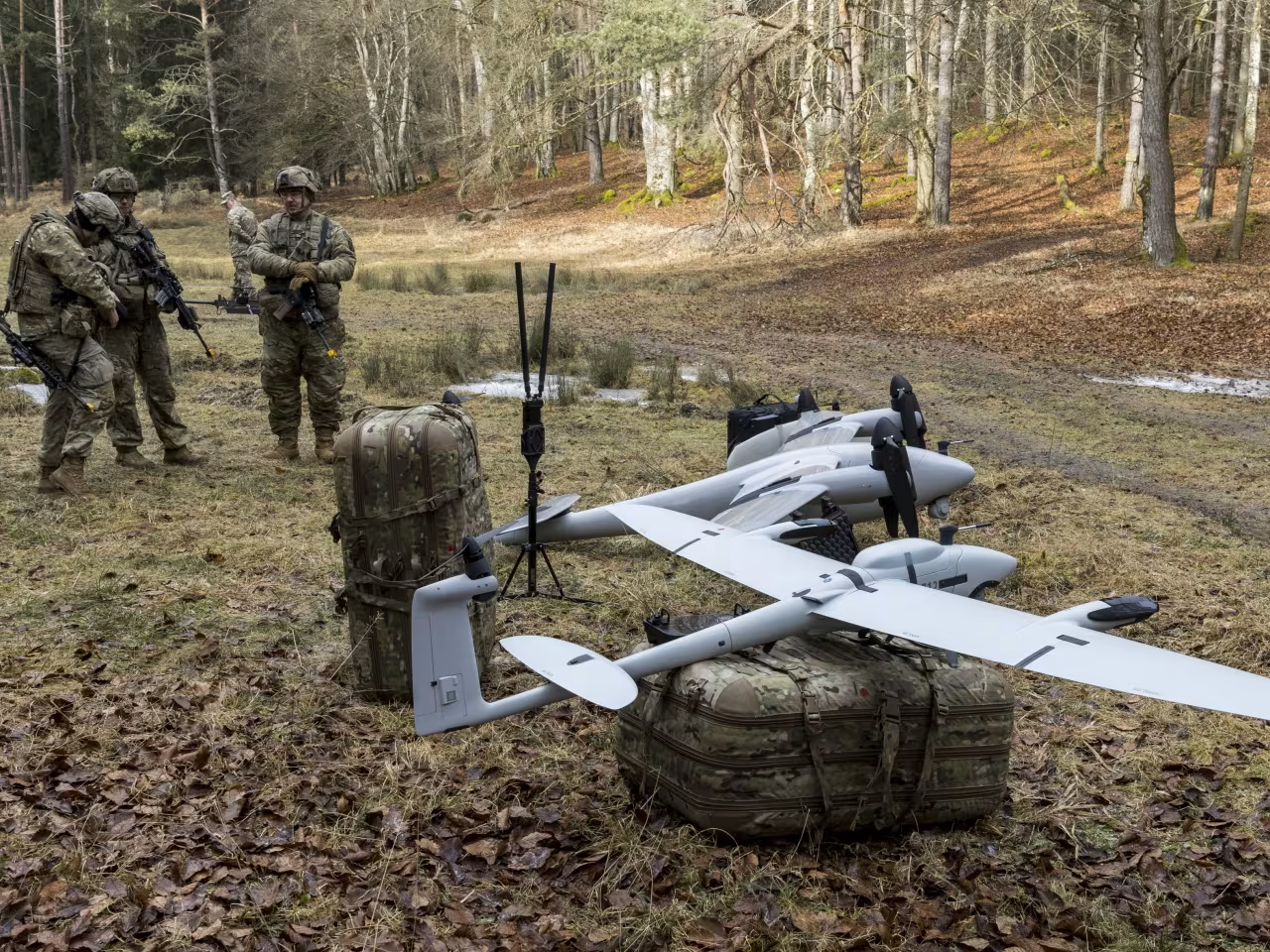
VTOL ACP is designed to operate from all current and future Royal Navy aviation-capable platforms, marking a strategic shift toward uncrewed aviation. The Malloy Aeronautics TRV 150 VTOL UAV, initially procured for Royal Marines logistics, will be trialed aboard HMS Prince of Wales during CSG25 as part of the Maritime Intra-Theatre Lift (MITL) programme. “The intention is to develop this capability during the forthcoming CSG25 deployment, to lessen the burden on crewed platforms that can then focus on more complex, high-priority tasking,” said Cdre Bolton. He added, “What we’re going to try and do is operate it at the same time as we operate crewed aircraft, which is no mean feat.”
The QEC carriers have already demonstrated their suitability for UAS operations. Under Project ‘Desert Skies’ in November 2023, the Royal Navy successfully launched and recovered a General Atomics Mojave UAV from HMS Prince of Wales off the US East Coast. Cdre Bolton described the trial as “a highly successful milestone in proving that UASs can seamlessly integrate with QEC carriers, and informed our approach to replacement of Crowsnest.” Mojave remains the largest UAS launched from an RN carrier to date, and the Navy is now assessing larger short take-off/landing UAVs for future AEW roles.
International collaboration is a key enabler. “If we can leverage existing fleets and develop international partnerships, there is added benefit of interoperability and interchangeability with our allies,” noted Cdre Bolton. The QEC’s design features, such as the ski jump flight deck, allow consideration of larger air vehicles, while the short take-off/vertical landing (STOVL) operational model offers flexibility to launch and recover different aircraft types simultaneously.
The Royal Navy currently operates around 40 UAS within a broader inventory of approximately 300 uncrewed systems. These include the Malloy TRV 150, AeroVironment Puma, QinetiQ Banshee Jet 80+, and Peregrine, the latter based on the Schiebel S100 Camcopter and providing 24-hour tactical ISR for deployed frigates. Additional systems are expected through initiatives such as the Heavy Lift Challenge, focused on autonomous airborne resupply, and the Proteus Technical Demonstrator, aimed at enhancing collaboration between uncrewed aviation and surface platforms.
The Navy’s maritime aviation transformation plan, extending to 2040 and beyond, seeks to transition most logistics, ISR, and strike functions to uncrewed platforms. Core themes include a threat-led, capability-driven approach, maximising automation, modular integration for rapid capability growth, and scaling operations from small beginnings to larger, more complex deployments. “What [uncrewed capability] will do for us is build back mass, and give us the opportunity to stay airborne for longer and reduce the risk to our people,” said Cdre Bolton.
“Our aim is to increase combat mass by initially introducing uncrewed systems in an additive manner, to build operating experience, and understand how best to optimise the concept of employment for uncrewed aviation – with or without crewed aircraft teaming,” he continued. The transition will be phased and conditions-based rather than driven by fixed timelines. “When we talk about scaling up, we’re talking about it in two formats: complexity, and numbers,” Cdre Bolton emphasised.