

Vertical Aerospace Unveils VA-1X eVTOL Air Taxi
Vertical Aerospace has introduced the VA-1X, a vectored-thrust electric vertical takeoff and landing (eVTOL) aircraft aimed at entering commercial service by 2024. The British company’s latest design marks a decisive shift from its earlier Seraph multicopter, adopting a configuration optimized for efficiency in cruise flight.

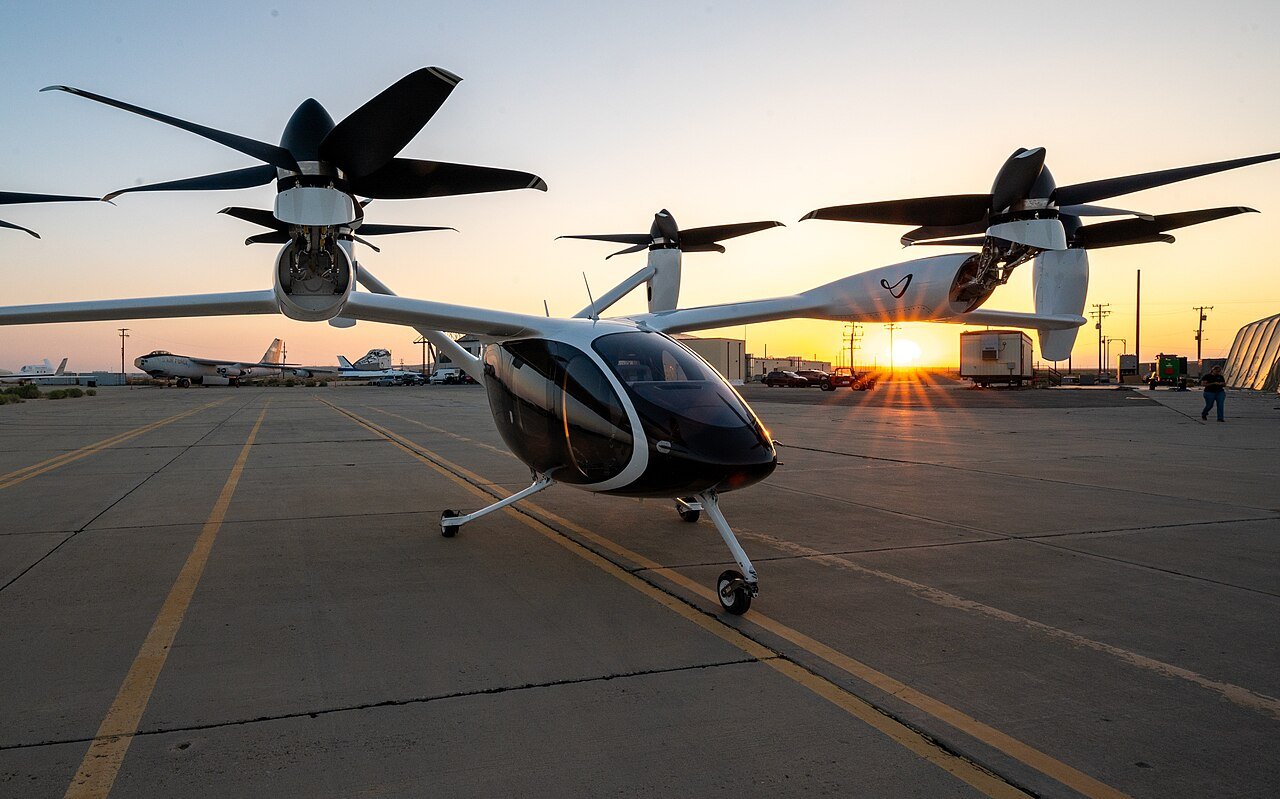
The VA-1X is specified to achieve a 100-mile range at a cruise speed of 150 mph, while producing noise levels claimed to be 30 times quieter than a conventional helicopter. Payload capacity is listed at 992 lbs, accommodating four passengers plus luggage and a pilot. The airframe features a 49-ft wingspan, V-shaped tail, and eight propulsors—four fixed units mounted aft on the wings to assist with vertical lift, and four forward units capable of tilting to transition the aircraft into forward flight.
Vertical Aerospace’s website notes that such performance could enable trips from London to Brighton in roughly 30 minutes, compared to two hours by car or one hour by train. This marks a stark contrast to the Seraph, which used twelve overhead rotors to lift 550 lbs at speeds up to 50 mph. The VA-1X’s adoption of vectored thrust and aerodynamic control surfaces reflects a deliberate move toward a more complex, certification-intensive design that promises broader transport applications.
Industry observers have taken note. “Without even trying, the VA-1X could compete on ~10% of the UK’s weekly frequency for the 2017 schedule,” commented Darrell Swanson of Swanson Aviation Co., adding that there are “lots of opportunities in the north providing much-needed Public Service Obligation flights. The real opportunity is where there are no scheduled services.” Eric Allison, head of Uber Elevate, also voiced support, noting similarities to Uber’s 2017 common reference models intended to guide eVTOL manufacturers.
The VA-1X’s development leverages Dassault Systèmes’ 3DEXPERIENCE cloud-based platform and draws heavily from Formula One engineering expertise. In late 2019, Vertical acquired MGI Technologies, a Formula One R&D firm, bringing advanced composite fuselage design, crash and fatigue analysis, and aerodynamic testing capabilities in-house. The company has expanded its supplier agreement with Honeywell to include flight controls and flight deck technologies for the new aircraft, with additional suppliers yet to be disclosed.
CEO Michael Cervenka stated, “With the launch of the VA-1X, we’re proud to be taking eVTOL one step closer to mass-market adoption, and supporting the next era of aviation. At Vertical Aerospace we believe that people should be able to quickly and affordably get from A to B without sacrificing the planet – with the VA-1X, this vision will start to be realized in under five years.”
Despite the ambitious timeline, Vertical has yet to construct a physical prototype. Achieving European Union Aviation Safety Agency (EASA) type certification and production approval for such a complex aircraft will be a significant undertaking. The company intends to bypass sub-scale prototyping, proceeding directly to a full-scale build while testing individual systems such as propellers. Dean Moore, formerly Boeing’s lead flight test engineer, has been hired to oversee the flight test campaign from Bristol.
A Vertical Aerospace representative explained the rationale for moving away from multicopter designs: “Multicopters are great, but they are not efficient for longer flights which is where we see the benefit of being in this market.” This reflects a broader industry trend toward wing-borne lift-plus-cruise and vectored-thrust configurations for extended range.
Chinese eVTOL developer EHang, known for its two-passenger 216 multicopter with a 21-mile range, has also signaled interest in longer-range designs. On its August 25 earnings call, founder and CEO Huazhi Hu stated, “We expect to roll out more new products, including the one with a flight range of over 100 kilometers, opening up more market opportunities. We believe 200 percent revenue growth is achievable as our continuous efforts in innovation lead to stronger development.”