


Perseverance Delivers One of Mars’ Sharpest Panoramas
NASA’s Perseverance rover has returned one of its most striking views yet from the Martian surface, capturing a 360-degree panorama under unusually clear skies. The images, taken on May 26, 2025, at a site named “Falbreen,” were assembled from 96 individual frames recorded by the rover’s Mastcam-Z instrument. The result is a mosaic that reveals fine details of the surrounding terrain, from distant hills to subtle surface textures.
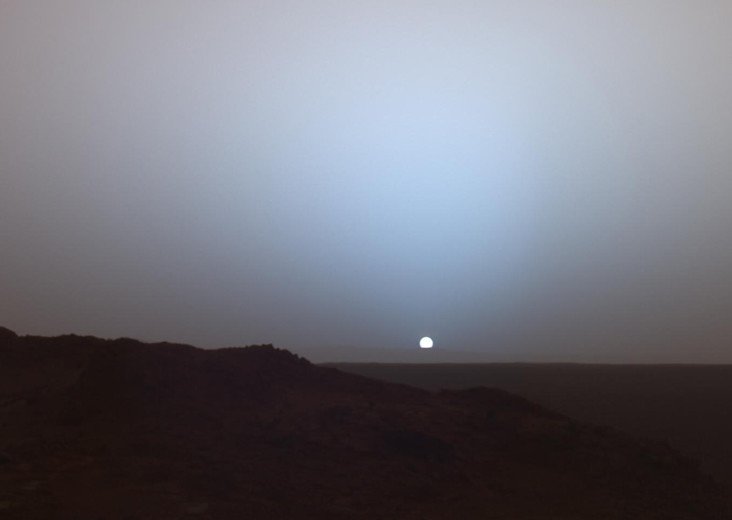
In the enhanced-color version of the panorama, the Martian sky appears a vivid, deceptive blue, a product of image processing that boosts contrast to highlight differences in terrain and atmosphere. The natural-color rendering shows the more familiar reddish hue. Jim Bell, Mastcam-Z’s principal investigator at Arizona State University, noted, “The relatively dust-free skies provide a clear view of the surrounding terrain. And in this particular mosaic, we have enhanced the color contrast, which accentuates the differences in the terrain and sky.”
The location offers a rich mix of geological features. A prominent “float rock” sits atop a dark, crescent-shaped sand ripple about 4.4 meters from the rover. Such rocks are thought to have originated elsewhere before being transported to their current positions, possibly by landslides, water flow, or wind activity. The science team suspects this rock was deposited before the sand ripple formed, adding another layer to the site’s complex history.
Near the center-left of the mosaic lies a bright white abrasion patch, the 43rd such feature Perseverance has created since landing in Jezero Crater in February 2021. Measuring about 5 centimeters across, these patches are produced using the rover’s drill to remove weathered material, exposing fresh rock for analysis. This particular abrasion was made on May 22, followed by proximity science two days later using arm-mounted instruments. The investigation aims to determine the composition and history of Falbreen, which may represent some of the oldest terrain the rover has examined, potentially predating Jezero Crater itself.
Tracks from Perseverance’s journey are visible toward the right edge of the panorama, curving left and disappearing toward a previous study site known as “Kenmore.” Above these tracks, a distinct boundary separates two geologic units: lighter-toned, olivine-rich rocks closer to the rover, and darker, clay-bearing rocks believed to be much older. This contact zone offers scientists a rare opportunity to study transitions between different periods of Martian geological history.
The clarity of the panorama is due in part to favorable atmospheric conditions. Mars’ thin atmosphere often carries fine dust that can obscure distant features, but on this sol—Perseverance’s 1,516th day on Mars—the skies were notably free of haze. This allowed Mastcam-Z’s zoom-capable optics to resolve details as far as 65 kilometers away, including distant hills along the horizon.
Sean Duffy, acting NASA administrator, connected the rover’s achievements to broader human exploration goals: “Our bold push for human space exploration will send astronauts back to the Moon. Stunning vistas like that of Falbreen, captured by our Perseverance rover, are just a glimpse of what we’ll soon witness with our own eyes. NASA’s groundbreaking missions, starting with Artemis, will propel our unstoppable journey to take human space exploration to the Martian surface. NASA is continuing to get bolder and stronger.”
Perseverance’s work at Falbreen is part of a broader campaign to collect and cache rock and soil samples for possible return to Earth. Each abrasion and core sample is carefully documented, with the potential to provide unprecedented insights into Mars’ past environments. The rover’s ascent to the top of Jezero Crater’s rim late last year opened access to new terrains and geological contacts, expanding the mission’s scientific reach.
NASA’s Jet Propulsion Laboratory, managed by Caltech, oversees rover operations for the agency’s Science Mission Directorate. Mastcam-Z’s design, fabrication, and operation are led by Arizona State University in collaboration with Malin Space Science Systems, ensuring the instrument continues to deliver high-resolution, scientifically valuable imagery from the Martian surface.