

Blue Origin Advances New Glenn Assembly at LC-36
As January 2024 drew to a close, Blue Origin’s work on its orbital-class New Glenn rocket reached visible milestones at Launch Complex 36 (LC-36) in Florida. The company’s transition from the suborbital New Shepard to the towering New Glenn — 98 meters in height and seven meters in diameter — has brought new engineering challenges in design, manufacturing, transportation, and testing. Despite the scale-up, production lines are active, with flight hardware for multiple rockets underway and initial tankage testing already in progress.

On December 18, 2023, a first stage liquid oxygen tank section was seen outside Blue Origin’s Exploration Park facilities near Kennedy Space Center. This, along with other tank sections spotted in recent months, indicated that several New Glenn first stages were in simultaneous production. The activity suggested a strategy to accelerate operational readiness once the rocket enters service.
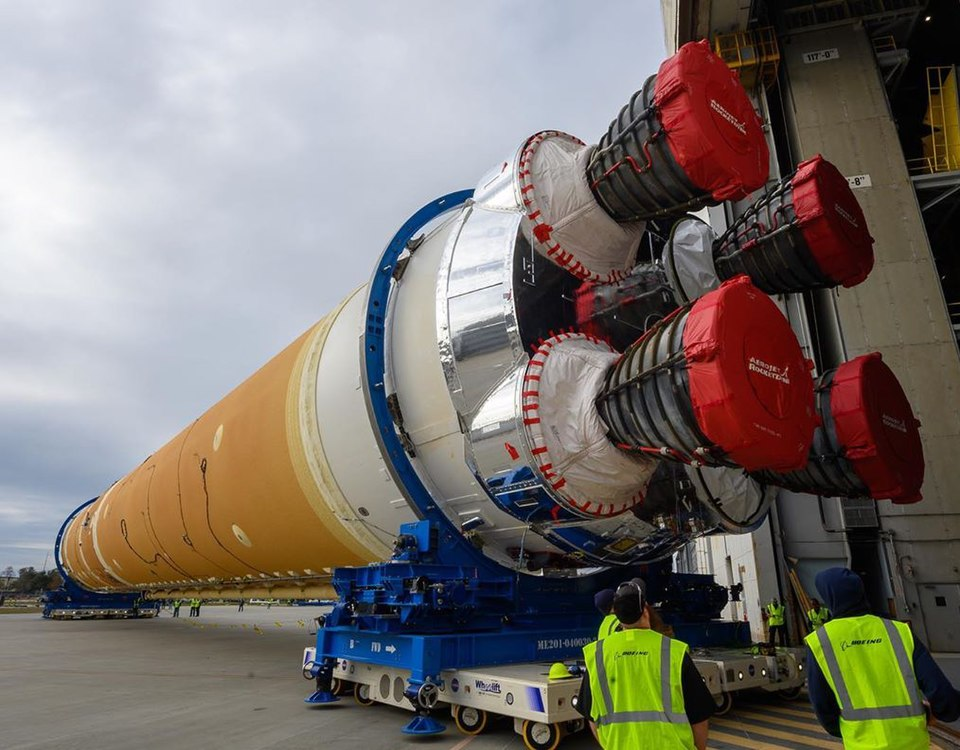
The logistics of moving such large structures were evident in early January. On January 3, the company’s custom transport system — designed to carry New Glenn’s first stages between Exploration Park and LC-36 — returned to the factory, signaling an imminent hardware move. That move came on January 10, when Blue Origin rolled out the most complete New Glenn first stage yet seen publicly, designated Glenn Stage 1 (GS1). Unlike the GS1 simulator used in November 2021, which replicated size and mass without functional tankage, this booster incorporated actual propellant tanks along with forward and aft modules, reaching its full length of nearly 58 meters.
The GS1 booster lacked certain flight components, including four control fins on its interstage and two large strakes at the aft end of the tank section. The status of its BE-4 engines remained undisclosed. The interstage bore “NOT FOR FLIGHT” markings, but the tankage appeared capable of supporting cryogenic propellant loading. This readiness pointed toward upcoming tests at LC-36, giving crews hands-on experience with fueling operations and validating ground support systems.
Transporting the booster from factory to launch site involved a 35-kilometer road journey — a complex move that Blue Origin aims to streamline. In late 2023, the company filed plans for a Refurbishment Facility just two kilometers from LC-36. Once New Glenn begins reusable operations, boosters returning to Port Canaveral will be taken to this nearby facility for turnaround work, reducing road closures and transit time.
On January 11, new CEO David Limp posted two images on LinkedIn. One showed the first stage inside the LC-36 hangar after rollout; the other depicted a second stage lying horizontally, fitted with two BE-3U engines at its aft end. The mounting structure carried “NOT FOR FLIGHT” markings, but the stage was likely suitable for cryogenic testing. This second stage differed from one tested at LC-36 in 2022, and with a dedicated transporter erector now available, pad-based tests with integrated BE-3U engines appeared possible.
Less than two weeks later, Blue Origin shared an image of the first and second stages mated inside the LC-36 hangar — the first such integration for New Glenn hardware. This step opened the way for lifting the vehicle onto the transporter erector and moving it to the pad for full-scale testing.
On January 25, observers spotted both a first stage liquid oxygen tank and a second stage tank section outside their respective test facilities at Exploration Park. The sight underscored ongoing parallel production of multiple rockets.
Engine development and qualification continued in parallel. Reports of test firings from Stand 4670 at NASA’s Marshall Space Flight Center in Alabama grew more frequent. Historically used for BE-3U testing, the stand will soon host BE-4 trials. The proximity of Blue Origin’s BE-4 production site — just 12 kilometers away — offers logistical advantages over the company’s Van Horn, Texas, test facilities.
Confidence in the BE-4’s performance was bolstered by its role in United Launch Alliance’s Vulcan rocket debut, where two BE-4 engines delivered approximately 10 minutes of total burn time. This success provided valuable operational data and reinforced readiness for New Glenn’s forthcoming flight campaigns.