

EHang Advances Toward Chinese Certification of Autonomous Air Taxi
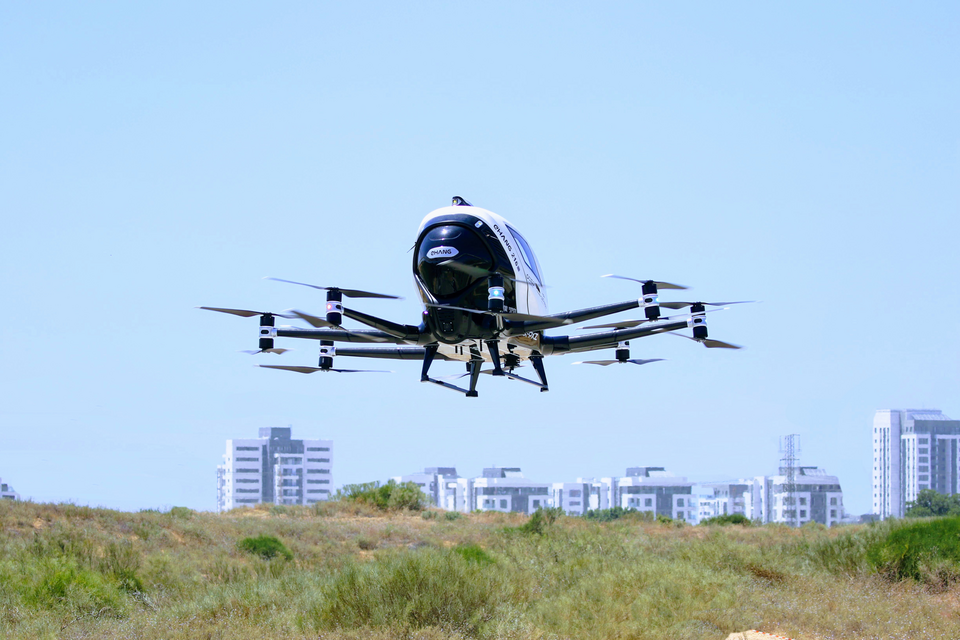
EHang, the China-based developer of electric vertical takeoff and landing (eVTOL) aircraft, has outlined its plan to secure type certification for its 216-S autonomous air taxi from the Civil Aviation Administration of China (CAAC) by mid-2022. The company intends to commence commercial passenger operations soon after. “We aim to be the first firm to launch commercial operational service in the world, probably in the second half of the year,” said Edward Xu, EHang’s chief strategy officer during an earnings teleconference.
The 216-S is a two-seat autonomous air vehicle (AAV) with a top speed of 130 km/h (70 knots), a payload capacity of 220 kg, and a range of 35 km (19 nm). Designed for short-range urban missions, the aircraft’s operational profile targets aerial mobility applications such as sightseeing, logistics, and firefighting. Xu emphasized the importance of building a “real flight record” to support certification efforts, noting that EHang has conducted more than 20,000 autonomous trial flights across 11 countries.
Central to EHang’s operational vision is its centralized AAV management platform, capable of overseeing multiple aircraft through cluster management technologies. This infrastructure is complemented by the company’s 5G Intelligent Air Mobility Experience Center in Guangzhou. The facility functions as a vertiport, integrating battery charging, maintenance hangars, and operational support systems, and serves as a demonstration hub for China’s emerging eVTOL industry.
The CAAC’s publication of special conditions for the 216-S in December marked a significant regulatory milestone. These conditions establish the framework for airworthiness certification of autonomous aerial vehicles in China, setting precedents for future designs. EHang’s approach aligns with broader industry trends in urban air mobility, where regulators are defining safety and performance benchmarks for autonomous passenger-carrying aircraft.
Beyond domestic efforts, EHang has been cultivating partnerships in Southeast Asia and Japan. Collaborations include Prestige Aviation in Indonesia, Aerotree Group in Malaysia, and AirX along with the Okayama Kurashiki Mizushima Aero & Space Industry Cluster Study Group in Japan. Such alliances are intended to pave the way for regional adoption and operational trials, leveraging local infrastructure and market interest.
Financially, EHang reported fourth-quarter 2021 revenues of 8.7 million RMB ($1.4 million), down from 13 million RMB ($2 million) in the prior quarter. Full-year revenues for 2021 totaled 56.8 million RMB ($8.9 million), a significant decrease from 180.1 million RMB ($28.4 million) in 2020. Adjusted operating expenses rose to 246.6 million RMB ($38.8 million), reflecting a 62.6% increase over 2020 levels. “We continue to maintain significant R&D expenditures for the development of AAV models, including the EH216 series, VT-30, and the other new models along with their related operating systems with enhanced functionalities, as well as for the growing R&D team,” said Richard Liu, EHang’s chief financial officer.
The VT-30, EHang’s long-range two-passenger AAV, is designed for missions up to 300 km (162 nm), extending operational reach well beyond the 216-S’s urban focus. This model supports EHang’s strategy to address both short-haul city transport and intercity mobility.
Looking ahead, chief operating officer Xin Fang projected 2022 revenues between 190 million RMB ($29.9 million) and 210 million RMB ($33.08 million), with most income expected in the latter half of the year. “We expect our revenues in 2022 will mainly come from air mobility uses, including aerial sightseeing, aerial firefighting, and aerial logistics, as well as smart city management aerial,” Fang said.
EHang’s trajectory reflects the convergence of autonomous systems, electric propulsion, and urban infrastructure planning. The company’s progress toward certification, coupled with its operational testing and international partnerships, positions it as a prominent player in the global race to commercialize autonomous air taxis.