

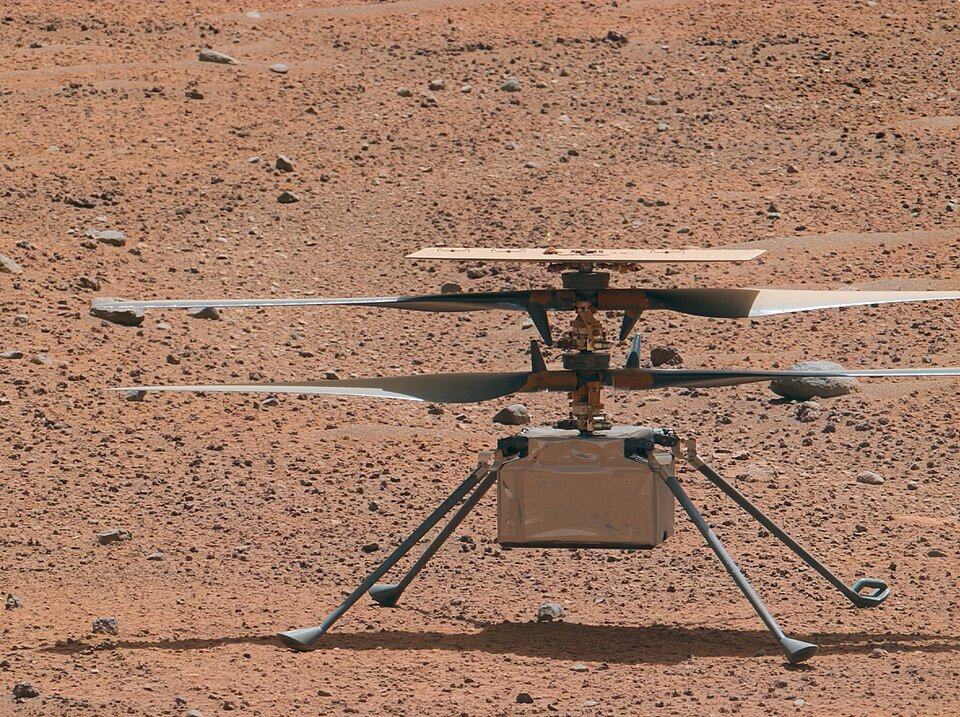
Ingenuity’s Record-Breaking Mars Flight Supports Perseverance’s Life Hunt
On July 24, 2021, NASA’s Ingenuity Mars Helicopter achieved its 10th and most complex flight to date, marking a significant milestone for the rotorcraft that was originally expected to fly only five times. Operating far beyond its initial technology demonstration phase, Ingenuity now serves as an aerial scout for the Perseverance rover, aiding in the search for signs of ancient life on Mars.
Ingenuity arrived on the Red Planet attached to Perseverance’s underside, shielded from debris during entry and landing on February 18, 2021. The debris shield was released on March 21, and by April 3 the helicopter stood on the Martian surface at a site named “Wright Brothers Field.” After rotor checks and surviving frigid Martian nights, Perseverance positioned itself at Van Zyl Overlook to document the first powered flight on another planet.
That inaugural flight on April 19 was a controlled vertical hop to three meters, lasting 39.1 seconds. Subsequent flights quickly expanded the envelope. Flight 2 reached five meters and incorporated lateral maneuvers. Flight 3 covered 100 meters at 2 m/s, capturing an image of Perseverance in the distance. By Flight 4, Ingenuity was traveling 266 meters roundtrip at 3.5 m/s, still launching and landing at Wright Brothers Field.
Flight 5, on May 7, broke that pattern, landing at a new site after covering 129 meters at 10 meters altitude. This concluded the technology demonstration phase. The operations demonstration phase began with Flight 6, which introduced scouting for Perseverance. During that sortie, Ingenuity experienced an in-flight anomaly traced to incorrect image timestamps in its navigation camera system. Despite instability, it landed within five meters of its target.
To avoid recurrence, Flights 7 and 8 omitted the navigation camera system, both successfully relocating the helicopter. Flight 9 pushed range limits with a 625-meter traverse across the Séítah region at 5 m/s, surpassing Perseverance’s total ground distance traveled since landing.
Flight 10 introduced a new level of complexity: ten waypoints, a record altitude of 12 meters, and targeted imaging of a rocky outcrop known as “Raised Ridges.” NASA JPL noted, “The #MarsHelicopter’s success today marks its 1-mile total distance flown. It targeted an area called ‘Raised Ridges.’ This is the most complex flight yet w/ 10 distinct waypoints and a record height of 40 ft (12 m). Its scouting is aiding @NASAPersevere.”
While Ingenuity charts aerial paths, Perseverance has transitioned into full science operations. “We are putting the rover’s commissioning phase as well as the landing site in our rearview mirror and hitting the road,” said Jennifer Trosper, Perseverance project manager at NASA’s Jet Propulsion Laboratory. The rover’s first campaign focuses on two regions: the Séítah area, with dunes, bedrock, ridges, and layered rocks, and the Crater Floor Fractured Rough, composed of exposed bedrock.
Due to uncertain terrain in Séítah, Perseverance will initially skirt its boundary before attempting a cautious “toe-dip” into a dune. Ingenuity’s aerial imagery, particularly from flights over Raised Ridges, provides critical context for targeting areas of potential astrobiological interest.
Perseverance’s 2-meter robotic arm, equipped with a drill, camera, and X-ray spectrometer, is central to its mission. After extensive testing, the arm is now fully operational. The rover will use it to collect core samples roughly the size of a piece of chalk. The process involves the Adaptive Caching Assembly retrieving a sample tube, heating it, and inserting it into a coring bit. The drill then extracts material, which is sealed in the tube and stored onboard.
These samples are intended for return to Earth through a multi-mission campaign. A European Space Agency Sample Fetch Rover, launching in 2026 alongside a Mars Ascent Vehicle, will collect deposited tubes. The ascent vehicle will deliver them to an ESA Earth Return Orbiter for transport back to Earth in 2029. Once here, scientists will be able to study Martian material with laboratory instruments far beyond the capabilities of current rover payloads.
Ingenuity’s continued health and performance provide valuable reconnaissance for Perseverance’s traverse planning, enhancing the efficiency and safety of the rover’s search for ancient biosignatures within Jezero Crater’s complex geology.