

NASA Unveils First Mars Audio and Landing Video
NASA has released unprecedented sensory data from the Perseverance rover’s arrival on Mars, including the first audio ever captured from the planet’s surface and high-definition video of its descent. The audio, a faint crackling punctuated by a gust of wind, was recorded after the rover touched down in Jezero Crater. “What you hear there 10 seconds in is an actual wind gust on the surface of Mars picked up by the microphone and sent back to us here on Earth,” explained Dave Gruel, lead engineer for Perseverance’s camera and microphone system.
The accompanying three-minute, 25-second video offers a detailed view of the rover’s entry, descent, and landing sequence. It shows the deployment of a red-and-white parachute with a 21.5-meter-wide canopy, the separation of the heat shield after atmospheric entry, and the rover’s final touchdown in a cloud of Martian dust. “This is the first time we’ve ever been able to capture an event like the landing on Mars,” said Michael Watkins, director of NASA’s Jet Propulsion Laboratory. He added, “These are really amazing videos. We binge-watched them all weekend.” Thomas Zurbuchen, NASA’s associate administrator for science, described the footage as “the closest you can get to landing on Mars without putting on a pressure suit.”
Following the landing, Jessica Samuels, Perseverance’s surface mission manager, confirmed the rover’s systems were functioning as intended. “I am happy to report that Perseverance is healthy and is continuing with activities as we have been planning them,” she said. Engineers are currently evaluating potential sites for the first flight of Ingenuity, a small helicopter drone carried by the rover. Ingenuity’s mission is to attempt the first powered flight on another planet, a significant challenge given Mars’ atmosphere is only about one percent the density of Earth’s.
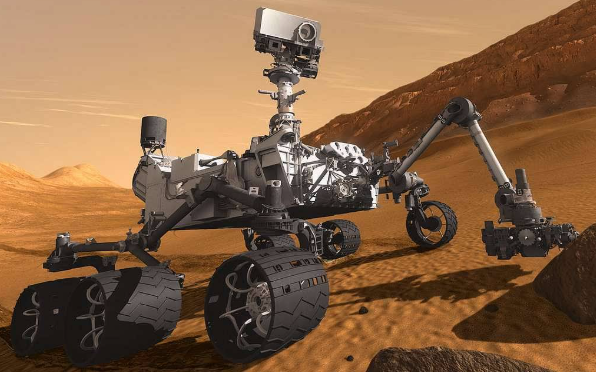
Perseverance, launched on July 30, 2020, is on a primary mission lasting just over two years, with expectations it could operate far longer, as demonstrated by its predecessor Curiosity, still active eight years after landing. Over its mission, Perseverance will collect 30 rock and soil samples in sealed tubes for eventual return to Earth in the 2030s. The rover, roughly the size of an SUV and weighing about a ton, carries a seven-foot-long robotic arm, 19 cameras, two microphones, and a suite of advanced scientific instruments.
Mars’ ancient climate was warmer and wetter, conditions that could have supported life. While prior missions established that the planet was once habitable, Perseverance’s goal is to determine whether it was actually inhabited. The rover will begin drilling its first samples in the Martian summer, deploying instruments to detect organic matter, analyze chemical composition, and use laser-induced breakdown spectroscopy to study vaporized rock material.
Among its experiments is a technology demonstration capable of producing oxygen from Mars’ carbon dioxide-rich atmosphere, functioning similarly to plant respiration. This capability could reduce the need for carrying oxygen on future crewed missions, vital both for human survival and for producing rocket propellant. Such engineering challenges highlight the interplay between planetary science and applied aerospace technology, as solutions developed for Mars exploration may influence broader fields from drone flight in thin atmospheres to autonomous robotics in extreme environments.
Perseverance is the fifth rover to operate on Mars, continuing a lineage that began in 1997, with all successful landings to date conducted by the United States. The mission is part of a longer-term vision that includes eventual human exploration of the Red Planet, though such plans remain in early stages. The data now streaming back—wind gusts across alien terrain, the unfurling of a parachute in the thin Martian air—offers engineers and scientists alike a rare, tangible connection to another world.