


AI-Driven Tendon-Based Robotic Hands Redefine Dexterity and Training Speed
In the Soft Robotics Lab at ETH Zurich, robotic hands are being completely reinvented. Instead of rigid, motor-driven joints, Professor Robert Katzschmann and his team have engineered artificial tendons that thread through rolling joints, creating fingers that move with a fluidity and adaptability far closer to the human hand. These hybrid musculoskeletal systems will merge soft and rigid materials to overcome the mechanical limitations that have long constrained robotic dexterity in unstructured environments.
1. Anatomy Inspired Actuation
This tendon-driven design is indeed biomimetic, emulating how biological muscles and tendons work in unison to provide strength with flexibility. The biologists in the lab are growing cell tissue for artificial tendons, while chemists craft the artificial muscles themselves-activated by electrical impulses that mimic neurotransmitters. This is also complementary to recent advances in fiber-type artificial muscles, where torsional, tensile, and bending actuation modes are optimized for natural motion. “Muscles provide softness, and the skeleton provides the load-bearing capacity needed for complex physical work,” Katzschmann stresses.
2. Dexterity with Multiple Fingers
The latest prototype has 21 degrees of freedom in the hand alone-mated with a robotic arm, the total is 28. This enables complex in-hand manipulation tasks beyond what simple grippers can accomplish. Multi-fingered hands have been indispensable in dexterous manipulation research to date; without them, tasks such as object relocation, pouring, and fine assembly-critical areas that rely on adaptability and precision-could not be performed.
3. Integration of Reinforcement and Imitation Learning
Training these hands relies on a combination of reinforcement learning and imitation learning. Human operators wear sensor-equipped gloves while external cameras capture the motion data, sometimes enhanced with virtual reality imagery. This data feeds transformer-based models—architectures akin to those driving large language models—that allow the robot to learn grasping strategies without explicit programming. As Katzschmann says, “The movement to pick up a bottle is now completely learned, and that makes the hand fantastically adaptable.”
4. Human-in-the-Loop Optimization
Demonstrations from human-in-the-loop RL systems incorporate corrections that can double task success rates within hours of training. This enables precise assembly and dynamic manipulation to realistic industrial tolerances, with robots reacting to small but critical variations in object placement.
5. Cloud-Based Parallel Training
At ETH’s Robotics Systems Lab, parallel reinforcement learning in simulated environments speeds up skill acquisition. “We use simulations to train thousands of robots at the same time,” Cadena says. Today, the lab generates as much data in one hour as it once did in a year. This is powered by high-performance GPUs, in collaboration with NVIDIA, many times, and enables fast policy development before deployment on physical robots.
6. Balancing Autonomy and Connectivity
While cloud-based training offers speed, reliance on constant connectivity can limit autonomy in remote operations. To address this, pre-trained models and partial computing capacity are directly embedded into robots. Cadena clarifies, “We sacrifice some processing power, but for clearly defined tasks, it’s usually still good enough,” which can enable robots, like disaster-response units, to also work without network access.
7. Material Science for Soft Robotics
The breakthrough on soft actuator material, especially the tendon-based approach, has benefited very well. Fiber-type artificial muscles, with spiral twisted configurations that may have a tensile strain of up to 8600%, have a high stroke and durability. Actuation is possible through various means of stimuli, including thermal, electrical, chemical, or moisture, allowing the robots to adapt to the conditions in the operating environment. Structural innovations, such as sheath-core designs and chirality modulation, further augment the level of performance and reliability.
8. Industrial Automation Potential
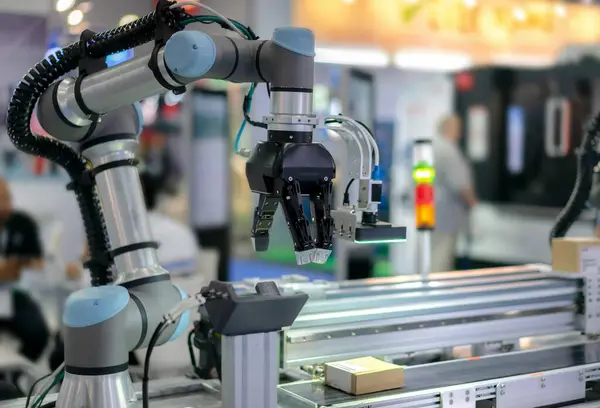
Spin-offs like Mimic Robotics and Flink Robotics now translate such advances into manufacturing and logistics solutions. Mimic Robotics develops AI-controlled, tendon-driven hands for sorting and packaging, while Flink Robotics combines AI vision with physical models to make standard industrial arms more intelligent. Swiss Post’s adoption of the technology from Flink to perform parcel operations is a signal that these systems have reached commercial viability.
9. Overcoming Limitations in Data
Purely data-driven methods often collapse under the burden of incredibly large demonstrations; folding a shirt, for instance, has required as much as 10,000 hours of training data with far-from-perfect results. Amalgamating learned policies with physical modeling, researchers reduce the quantity of data required while enhancing generalization. This hybrid approach enables robots to generalize throws, grasps, and manipulations using known physics sans exhaustive retraining. 10. Toward Versatile, Adaptive Robots The convergence of tendon-based mechanical design, advanced soft actuators, and efficient AI training pipelines is redefining robotic dexterity. Such designs will have to account for real-world unpredictability in everything from delicate surgical assistance to rugged field operations without sacrificing speed or precision by emulating human anatomy and leveraging scalable machine learning.