

Blue Origin Ramps Up for New Glenn’s 2024 Debut
For the first time in years, momentum appears to be building toward the inaugural flight of Blue Origin’s heavy-lift New Glenn rocket. The privately developed vehicle, standing more than 98 meters tall, has been delayed multiple times since its original target in 2020. Yet recent activity at the company’s Florida facilities suggests the long-awaited launch could occur within the next 12 months.

The two-stage New Glenn is designed to carry up to 45 metric tons to low-Earth orbit, placing it above the lift capacity of United Launch Alliance’s Vulcan or SpaceX’s Falcon 9, but below Falcon Heavy. Its 23-foot diameter payload fairing offers roughly twice the volume of SpaceX’s largest shrouds, enabling missions with larger or more complex payloads.
NASA has identified the rocket’s debut flight as a potential launch opportunity for ESCAPADE, a low-cost Mars science mission comprising twin spacecraft to study the planet’s magnetosphere. If ESCAPADE misses a 2024 launch, the mission would face a two-year delay. Laura Aguiar, a NASA spokesperson, noted that trajectory options are under review, including a direct Hohmann transfer to Mars that could extend launch availability further into the year.
Lars Hoffman, Blue Origin’s vice president of government sales, told attendees at the Space Force Association’s Spacepower Conference, “We’re now ready to really start amping things up a bit. We’ll start launching New Glenn next year.” He described a manufacturing floor near Kennedy Space Center filled with flight hardware—tanks, metallic structures, and other components—destined for the first launches. “The manufacturing pace is just picking up by the day,” Hoffman said. “In fact, we’re expanding the buildings there to support that scaling.”
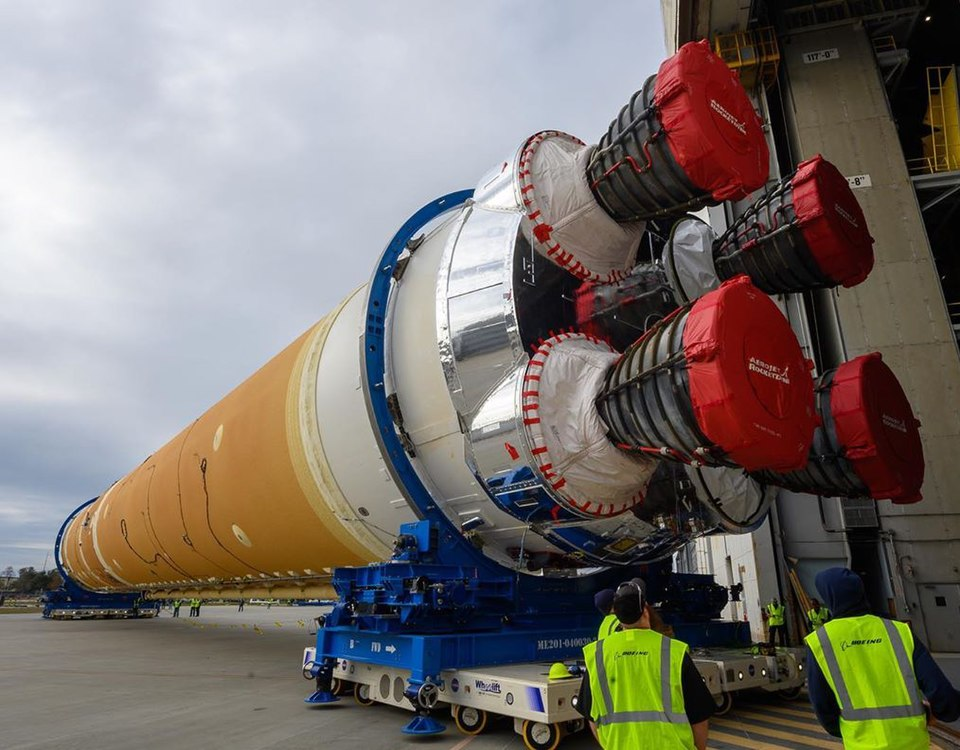
Recent sightings near Cape Canaveral have included the massive payload fairing on a transporter and a large section of a first stage booster bearing Blue Origin livery. Hoffman confirmed the fairing is now inside the hangar near the launch pad, though he declined to specify whether the booster is for flight or ground testing. With the launch site complete and located adjacent to the integration facility and payload processing areas, the company can streamline assembly and transport.
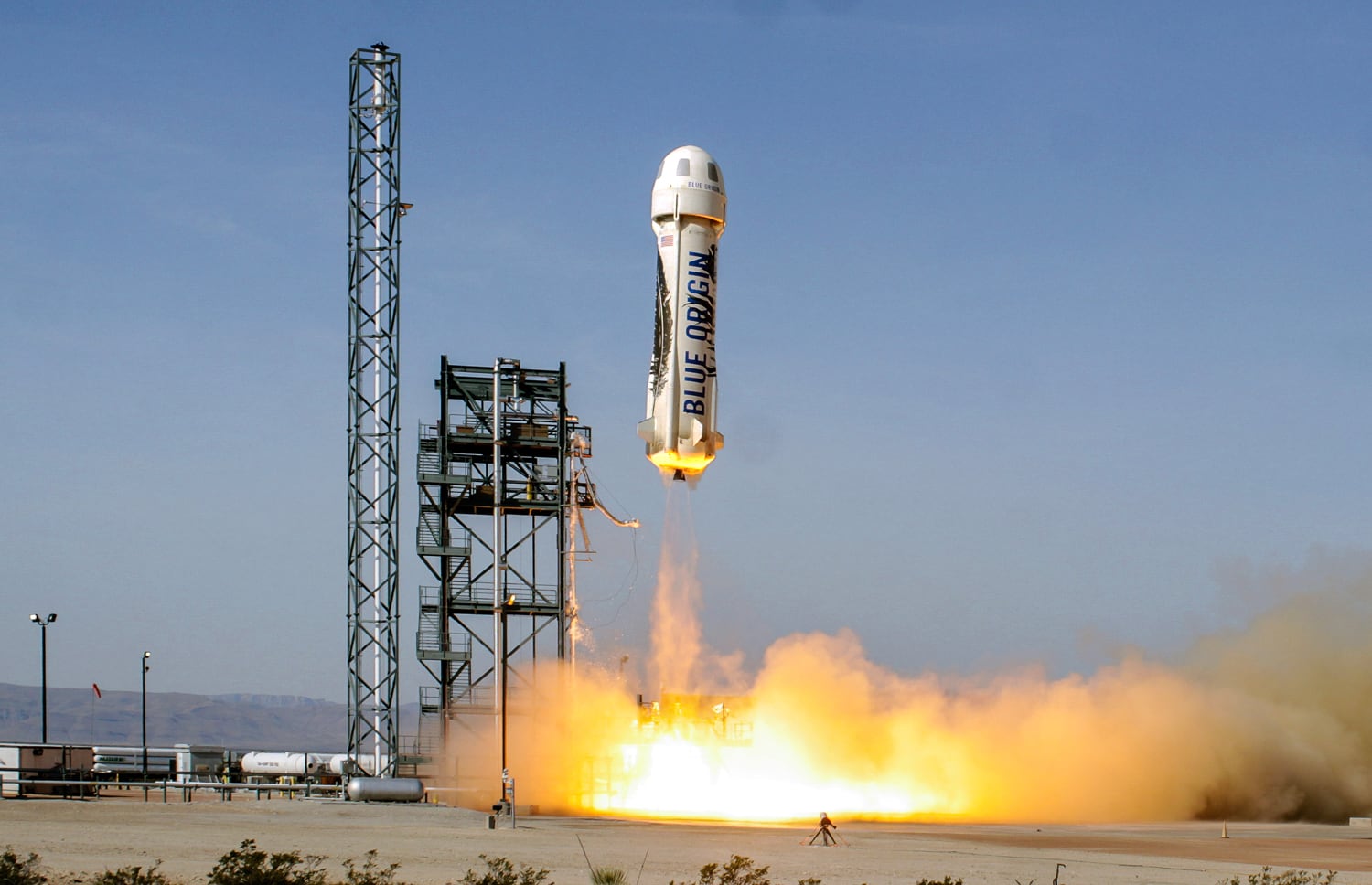
Engine testing will intensify in the coming months. Seven methane-fueled BE-4 engines will power New Glenn’s first stage, while two hydrogen-fueled BE-3U engines will drive the second stage. Variants of both engines will have flown before New Glenn’s debut; BE-4s are already slated for ULA’s Vulcan, and BE-3 variants power Blue Origin’s suborbital New Shepard. Hoffman pointed to Vulcan’s first flight, planned for January, as a significant milestone preceding New Glenn’s launch.
Ground teams in Florida are preparing to raise a New Glenn vertically on the pad for cryogenic propellant loading tests—wet dress rehearsals with methane and liquid oxygen. Such tests can reveal minor issues that extend timelines. Notably, Blue Origin does not plan a full-scale hotfire of the complete first stage before launch, a departure from standard practice seen with Vulcan, Ariane 6, and SpaceX’s Super Heavy.
The August 2024 target for ESCAPADE remains under review, with mission profiles adaptable to New Glenn’s capabilities. Hoffman emphasized the rocket’s reusability goals, stating, “We are on a path to full reusability in the long term, and that’s the goal.” The first stage is intended to land on a floating offshore platform from its first flight, with infrastructure at Port Canaveral to rotate recovered boosters for transport.
Founded in 2000 by Jeff Bezos, Blue Origin now employs around 11,000 people across sites in Washington, Texas, Alabama, and Florida. While it has yet to reach orbit, the company has secured a $3.4 billion NASA contract for a human-rated lunar lander and aims to compete with ULA and SpaceX for national security launches. Amazon’s Kuiper satellite constellation is also slated for future flights on Blue Origin rockets.
New Glenn’s success would mark a pivotal step in realizing Bezos’s long-term vision for space access, combining high payload capacity with reusability to lower costs and increase launch cadence.