


Panther UAS Brings Rugged Precision to Outdoor Rescue
Uniform Sierra Aerospace has introduced the Panther unmanned aircraft system, engineered specifically for outdoor search-and-rescue and first-responder missions. Designed and built entirely in the United States, the Panther addresses a growing need among public safety and government agencies for domestically produced drones capable of operating in challenging environmental conditions.

The company, founded by Purdue University alumni Duncan Mulgrew, Jeremy Frederick, and Trevor Redpath, positioned Panther as a direct response to recent legislative changes. The National Defense Authorization Act for fiscal year 2024 prohibits the use of federal grant funds to purchase Chinese-built drone equipment, a shift that has left many agencies seeking reliable U.S.-manufactured alternatives. “The primary challenge of outdoor operations is being able to operate no matter the weather conditions at the time,” said Mulgrew, Uniform Sierra Aerospace’s CEO. “In the event of a missing person case that requires search and rescue, our users can’t afford to ground their drone fleet if it’s windy or raining.”
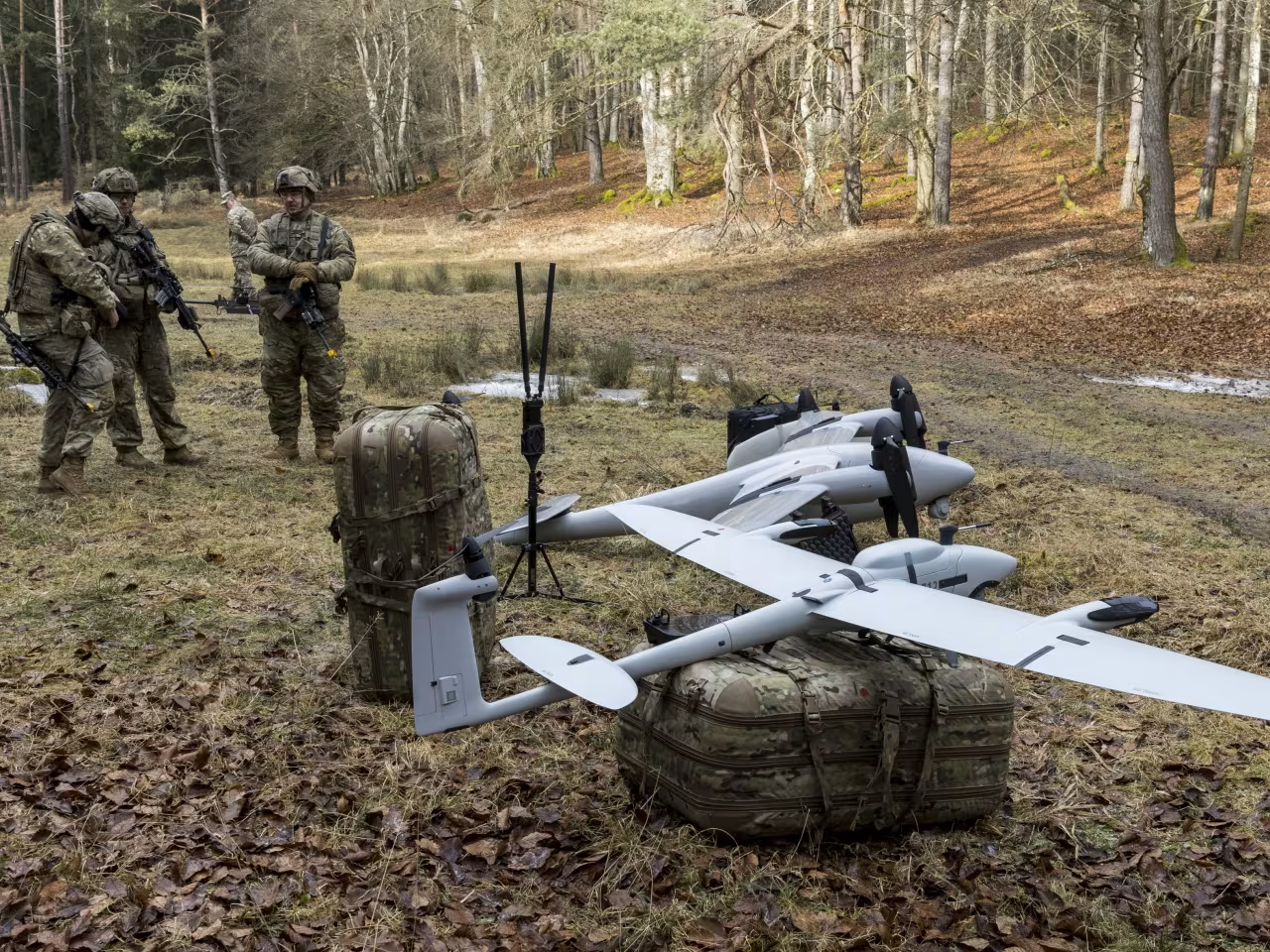
Panther’s airframe and systems have been calibrated for resilience. It can sustain flight in higher wind speeds than typical small UAS and is waterproofed to withstand rain and snow. The aircraft’s sensor suite is mechanically stabilized and integrates a 40x optical zoom camera alongside a thermal imaging unit, enabling operators to conduct long-range searches and surveillance while maintaining image clarity during rapid maneuvers. Mulgrew noted that Panther can fly for more than 45 minutes and cruise at 50 miles per hour under favorable conditions, extending its coverage area well beyond that of many competing systems.
Compliance with FAA regulations for night operations further expands its deployment window. Agencies can legally operate Panther after dark, a capability critical in time-sensitive rescue missions where daylight hours are limited. Mulgrew emphasized another operational advantage: low detectability. “Also, to ensure the safety of our operators in potentially dangerous deployments, Panther is built to be challenging to see and hear from the ground,” he said. “Even when it is as close to 300 feet to a subject, in the right conditions it is impossible to hear over ambient noise.”
The Panther joins Uniform Sierra Aerospace’s existing Arrowhead indoor UAS in the company’s portfolio. While Arrowhead is optimized for confined environments, Panther’s larger form factor accommodates higher-capacity batteries and more sophisticated camera systems, enabling effective performance over extended ranges. This design approach reflects a deliberate separation of mission profiles—indoor reconnaissance versus expansive outdoor search—allowing each platform to excel in its intended domain.
Uniform Sierra Aerospace’s development trajectory has been supported by Purdue Innovates, which awarded the company $100,000 in 2023. The funding facilitated a move to a new production facility within the Purdue Technology Center, part of the Purdue Research Park in West Lafayette. This incubator environment provides proximity to engineering talent and resources, reinforcing the company’s commitment to maintaining its manufacturing base in the U.S.
From an engineering perspective, Panther’s combination of mechanical stabilization, optical zoom, and thermal imaging reflects a convergence of sensor technologies that have matured significantly in recent years. Mechanical stabilization remains critical for maintaining image fidelity during high-speed flight or in turbulent air, where electronic stabilization alone can struggle. The inclusion of a 40x zoom enables identification and tracking of subjects from substantial distances, reducing the need for low-altitude passes that could compromise safety or stealth. Thermal imaging adds another layer of capability, particularly in locating individuals obscured by vegetation or operating in low-visibility conditions.
The waterproofing and wind tolerance suggest careful attention to sealing, structural rigidity, and aerodynamic stability. Achieving reliable performance in precipitation requires not only protecting electronics but also ensuring that propeller wash does not exacerbate water ingress. High wind capability often involves optimizing motor torque, propeller design, and flight control algorithms to maintain stability without excessive power draw.
By integrating these elements into a single platform, Uniform Sierra Aerospace has delivered a system tailored to the operational realities faced by first responders. Panther’s design underscores a broader trend in UAS development: the shift toward specialized platforms that address distinct mission requirements rather than relying on one-size-fits-all solutions.