

SpaceX Falcon Heavy Sends Final GOES-R Satellite to Orbit
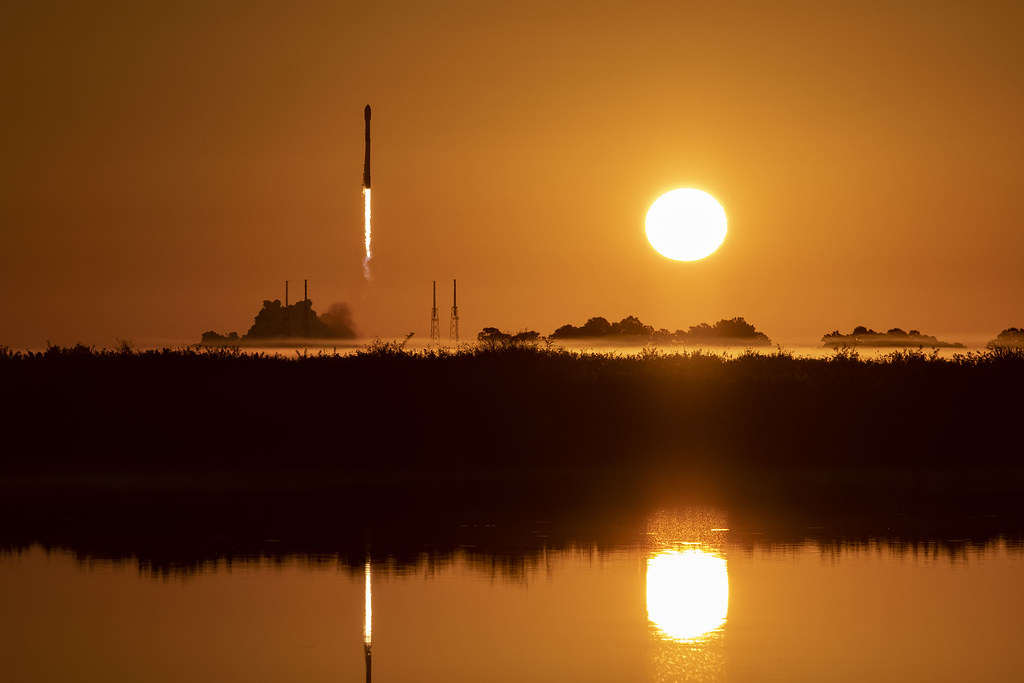
The fourth and final spacecraft in NOAA’s GOES-R series began its journey to geostationary orbit aboard a SpaceX Falcon Heavy, lifting off from Florida’s Space Coast at 5:26 p.m. EDT. GOES-U, built by Lockheed Martin, will join its three predecessors in delivering vital weather, climate, and solar data to forecasters and scientists, enhancing public safety and infrastructure resilience.

Launch conditions were initially challenging. Brian Cizek, launch weather officer with the 45th Weather Squadron, noted only a 30 percent chance of favorable weather early in the day. That probability improved to 70 percent by launch time. Cizek explained, “We evaluate a set of ten lighting launch commit criteria that are designed to protect not just against natural lightning, but rocket-triggered lightning. The rocket can actually trigger its own lightning strike if it flies through or near a cloud that could hold a charge by increasing the electric field in the atmosphere by up to 100 times.”
Falcon Heavy’s two side boosters, both new, returned to Landing Zones 1 and 2 at Cape Canaveral Space Force Station, producing twin sonic booms over the region. The center core was expended after separation. Julianna Scheiman, SpaceX’s director of NASA Science Missions, said, “With reusability, we’re reusing our vehicles, but we also need to replenish the fleet. And the decision that we made in coordination with the NASA Launch Services Program was that it makes sense for us to replenish the fleet now with these new boosters.”
This mission marked the first time a GOES-R series satellite launched on Falcon Heavy. NASA Launch Services Program director Denton Gibson described working with NOAA to adapt to the vehicle’s operations and culture. Lockheed Martin’s Pam Calderwood detailed modifications for horizontal integration with Falcon Heavy, replacing the vertical integration used on Atlas V. “The tipping of the spacecraft, all of the mechanical, specialized equipment to do that, a lot of it had to be updated, redesigned,” she said.
After separation roughly 4.5 hours post-liftoff, GOES-U will deploy most of its solar arrays to begin charging batteries. Calderwood emphasized, “The reason that’s so important is this spacecraft needs power to survive, if there’s any issues.” Two days after launch, a series of five liquid apogee engine burns over 14 days will raise the orbit to geosynchronous altitude, culminating around July 8. Once operational, GOES-U will be renamed GOES-19 and serve as the primary “GOES East” satellite alongside GOES-18 in the west.
GOES-U carries advanced Earth and solar observation instruments. A notable addition is the Compact Coronograph-1 (CCOR-1), developed by the Naval Research Laboratory, enabling frequent monitoring of the Sun’s corona. Calderwood noted, “The Sun, when it goes through and it has these types of geomagnetic storms or these eruptions, it can go through and create communication blackouts. It can create disruptions to power grids… And we’re all really excited to have this new piece of equipment on there that’s going to go through and help with that early warning detection.” CCOR-1 aims to provide one to four days’ notice of heightened solar activity, complementing the Solar Ultraviolet Imager (SUVI) and Extreme Ultraviolet and X-ray Irradiance Sensors (EXIS).
On the Earth-facing side, the Geostationary Lightning Mapper (GLM) and Advanced Baseline Imager (ABI) deliver high-resolution atmospheric data. ABI scans every 10 minutes across 16 spectral bands from visible to infrared. Chris Reith of L3Harris highlighted its wildfire detection capability: “It can pick up a fire as small as a small barn fire from 22,000 miles above Earth.”
Lessons from GOES-R will inform NOAA’s next-generation GeoXO satellites, with Lockheed Martin contracted to build three spacecraft targeting a 2032 debut. GeoXO’s imager will add spectral bands and sharpen resolution to 250 meters in visible wavelengths. Calderwood compared the upgrade to moving from a car built in the 1980s or 1990s to one designed today, noting the LM 2100 bus will allow periodic software updates in orbit.