

Global Launch Surge Showcases Spaceflight Milestones
Following the sixth flight of SpaceX’s Starship, the global launch cadence accelerated with eight additional orbital missions in a single week, spanning commercial, governmental, and experimental objectives. Rocket Lab opened the sequence with a hypersonic test mission from Wallops Island, Virginia, using a modified Electron designated HASTE. This suborbital flight, part of the Department of Defense’s Multi-Service Advanced Capability Hypersonics Test Bed program, carried a classified payload believed to be a hypersonic glide body. The HASTE variant incorporates custom fairings and a modified kick stage to accelerate payloads beyond Mach 5, supporting rapid technology maturation in hypersonics.
Less than 24 hours later, Rocket Lab’s standard Electron lifted off from Launch Complex 1 on New Zealand’s M?hia Peninsula, deploying five Kinéis nanosatellites into low-Earth orbit. Each 30-kilogram spacecraft contributes to a French Internet of Things constellation, with this batch including the 200th satellite launched by Electron. The vehicle’s architecture—carbon composite airframe, nine electric pump-fed Rutherford engines on the first stage, and a vacuum-optimized Rutherford on the second—demonstrates the company’s emphasis on lightweight structures and additive manufacturing.
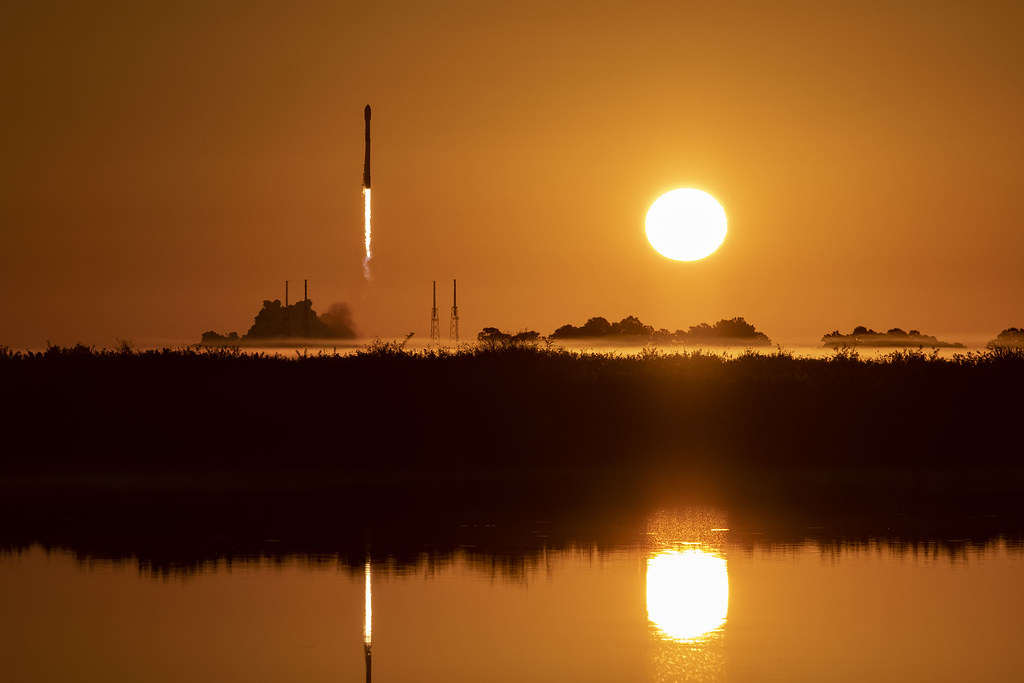
SpaceX maintained its near-daily Falcon 9 tempo with three Starlink missions. On Nov. 21, Starlink Group 6-66 departed from Cape Canaveral’s SLC-40 aboard booster B1069, marking Falcon 9’s 400th flight. B1069 achieved its 20th mission, becoming the seventh booster to reach that milestone, while the reused payload fairings set a fleet record with their 21st flights. This launch also set a new annual record for SLC-40 with 56 missions.
Two days later, Starlink Group 9-13 launched from Vandenberg’s SLC-4E on booster B1075’s 15th flight—all from the same site—underscoring SpaceX’s regional reusability strategy. This mission was also the company’s 100th launch from Vandenberg. On Nov. 25, Starlink Group 12-1 lifted off from SLC-40 using booster B1080, which set a new turnaround record of under 14 days. The payload included 23 v2 Mini satellites, 12 of which featured Direct to Cell capability, extending Starlink’s service potential.
Roscosmos contributed with the Progress MS-29 cargo mission to the International Space Station. Launched Nov. 21 atop a Soyuz 2.1a from Baikonur Cosmodrome, the spacecraft docked two days later, delivering 2,500 kilograms of supplies. The manifest included 869 kilograms of propellant, 420 kilograms of water, 42 kilograms of compressed nitrogen, and assorted crew provisions and experiments. The Soyuz 2.1a’s propulsion system—four RD-107A engines on the strap-on boosters, an RD-108A on the core, and an RD-0110 on the third stage—burns liquid oxygen and RP-1, a proven configuration for reliable orbital insertion.
Blue Origin’s New Shepard NS-28 flight on Nov. 22 marked the ninth crewed mission for the suborbital system. Launching from West Texas, the reusable booster NS5 completed its twelfth flight, while the RSS First Step capsule carried six passengers, including four first-time flyers. The vehicle crossed the Kármán Line before returning via propulsive booster landing and parachute-assisted capsule descent.
China closed the week with a Chang Zheng 2C launch from Jiuquan on Nov. 24, carrying two satellites identified in early reports as Siwei Gaojing-2 03 and 04, also known as Superview NEO 3 and 4 SAR. These synthetic aperture radar spacecraft add to China’s growing high-resolution Earth observation capabilities.
The week’s activity underscored several trends: the tightening turnaround cycles for reusable rockets, the operational maturity of small launch vehicles like Electron, and the integration of experimental defense payloads into commercial launch schedules. The rapid succession of missions from multiple continents highlighted the increasing normalization of high-frequency launch operations in both orbital and suborbital regimes.