

SpaceX Targets Booster Catch and Starlink Test in Starship Flight
SpaceX is preparing for the seventh test flight of its Starship launch system, now scheduled for Wednesday, Jan. 15, following weeks of readiness work at its Starbase facility in Boca Chica, Texas. This mission marks the first flight of 2025 for the 400-foot-tall vehicle and introduces two major objectives: a Starlink payload deployment test and another attempt to catch the Super Heavy booster at the launch pad.
The Federal Aviation Administration issued a launch license on Dec. 17, clearing the way for this milestone. SpaceX has described the vehicle as a “new generation” Starship, incorporating upgrades to the upper stage, propulsion system, and heat shield. “All add additional vehicle performance and the ability to fly longer missions,” the company stated. These enhancements build on progress made in 2024, including the October demonstration in which the booster was successfully caught by the launch tower’s mechanical arms.
For the first time, Starship will carry and attempt to deploy 10 Starlink simulators. These payloads, designed to match the size and mass of next-generation Starlink satellites, will follow the same suborbital trajectory as the spacecraft, with splashdown targeted in the Indian Ocean. This capability is critical for future missions where Starship could serve as a high-capacity satellite deployment platform.
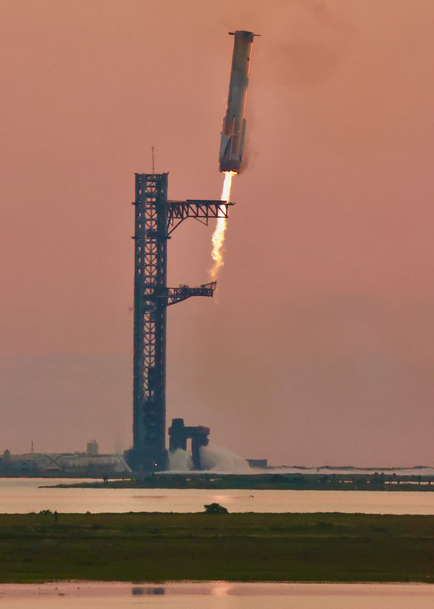
The booster catch maneuver will again be attempted, a feat that generates sonic booms in the vicinity of the landing zone. In November, during the sixth test flight, the catch was aborted due to damage sustained by sensors on the tower’s arms—nicknamed “chopsticks”—during a prior launch. For this mission, the tower has been fitted with protective hardware to prevent similar issues. The Super Heavy booster will also feature a Raptor engine previously flown on the fifth test flight, marking the first reuse of flight-proven hardware in the program. Additionally, SpaceX plans to reignite Raptor engines in space to attempt an orbital burn, a maneuver essential for controlled returns from orbit.
SpaceX’s ambitions for 2025 are substantial. The company conducted two Starship flights in 2023 and increased that number to four in 2024. Elon Musk has proposed scaling up to 25 flights this year, pending FAA approval. The agency has been gathering public feedback through meetings in Texas and an online session, part of its evaluation of SpaceX’s licensing request.
Starship is classified as a super heavy-lift launch vehicle and is the largest, most powerful rocket ever built. It consists of the 165-foot Starship spacecraft atop the 232-foot Super Heavy booster. Designed for full reusability, the system aims to transport humans and cargo to Earth orbit, the moon, and Mars. Under NASA’s Artemis program, Starship is slated to deliver astronauts from lunar orbit to the moon’s surface during the Artemis III mission. Musk has also outlined plans to send uncrewed Starships to Mars in late 2026, followed by crewed missions in 2028.
Flight testing has steadily advanced the vehicle’s capabilities. In June 2024, Starship achieved its first controlled splashdown in the Indian Ocean. The October booster catch demonstrated a key step toward rapid reusability, reducing turnaround time and launch costs. Each iteration has provided engineering data to refine systems ranging from thermal protection to engine performance.
The upcoming test will be closely watched by aerospace engineers, hobbyists, and industry observers. Its combination of payload deployment, hardware reuse, and complex recovery operations reflects SpaceX’s iterative approach—pushing forward with increasingly ambitious objectives while integrating lessons from prior flights.